
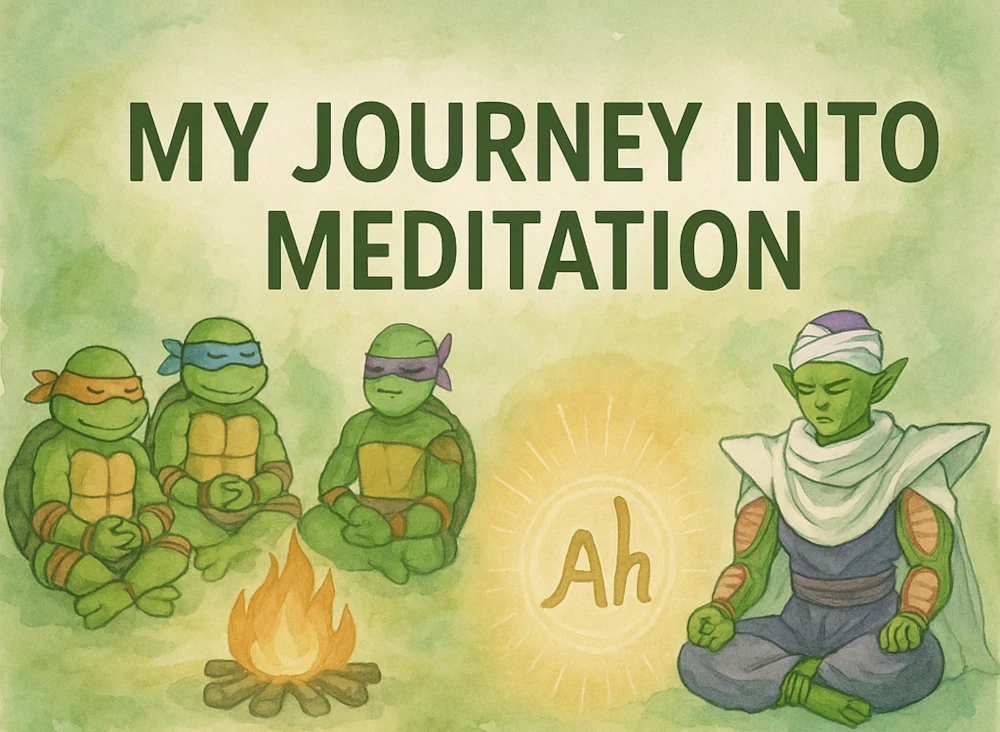
When I think back to the first time meditation caught my attention, it wasn’t in a classroom or a yoga studio — it was in front of the TV. I first noticed it in the Teenage Mutant Ninja Turtles movie, where the turtles meditated around a campfire.
Later, I noticed Piccolo meditating in Dragon Ball Z. At the time, I didn’t fully understand what they were doing, but it always seemed tied to martial arts, inner strength, and eastern philosophy. That planted the seed. Meditation And Mental Health is a topic that comes up often in therapy.
As I grew older, meditation kept resurfacing. Some of my high school friends would go to the beach to meditate. I didn’t always join in, but I was curious. Eventually, I got The Great Courses series on meditation.
The professor in that series left an impression on me. He explained how he turned to meditation because so many people around him were drinking, doing drugs, and making destructive choices. Meditation, for him, was a healthier alternative — free, available at any time, and it didn’t harm himself or anyone else. He described staying calm while a bee flew between his eye and his glasses mid-wedding sermon. That kind of presence fascinated me.
Later, as I trained to become a therapist, I realized meditation wasn’t just personal — it was evidence-based. Mindfulness had become a core part of ACT, cognitive-behavioral approaches, and stress reduction programs. Meditation wasn’t “out there” anymore; it was practical and accessible.
Three Meditations That Shaped Me and Meditation And Mental Health
One of the best resources I found was on PositivePsychology.com, which offered three practical mindfulness meditations I’ve returned to again and again:
- Eye of the Hurricane: This practice helps you see yourself as the calm center while thoughts and emotions swirl around you. It taught me about the “observing self” — the ability to stay grounded no matter what’s happening.
- Leaves on a Stream: A guided diffusion exercise where you place each thought on a leaf and watch it float downstream. Simple but powerful.
- Wheel of Awareness (Dan Siegel): A structured practice guiding you through four quadrants of awareness — sensing the world, scanning the body, observing mental activity, and expanding into connection with others.
What struck me about these three meditations is that they all used metaphors and visuals to make the practice easier to grasp. Each gave me a different angle on meditation, but together they showed me how flexible, creative, and useful the practice can be.
What to Expect When Working on Meditation in Therapy
Many people come in not knowing what to expect from therapy around meditation. The short answer: you won’t be pushed to talk about things before you’re ready, and you won’t be handed a list of affirmations and sent home. Real work on meditation involves building awareness of the patterns — when they show up, what triggers them, what they’re protecting you from — and then slowly building a different response.
The first few sessions are mostly about getting a clear picture of what’s actually going on. Meditation rarely exists in isolation. It usually connects to something deeper — a history, a pattern of relationships, a learned way of coping that made sense at some point and now doesn’t. Therapy creates the space to look at that connection directly.
Progress isn’t always linear. Some weeks things feel clearer; others, something gets stirred up and you leave feeling worse before you feel better. That’s normal. It usually means you’re getting closer to something real. What changes over time is your relationship to meditation — not just your ability to manage it, but your understanding of where it comes from and why it still shows up.
The CD That Sold Me on Meditation and Meditation And Mental Health
When I was 25 and newly in recovery, I found myself sinking into deep self-pity. I called someone from my sober network, and he showed up at my door with a burned disc: Meditation for Manifesting by Dr. Wayne Dyer.
Dr. Dyer’s calm voice filled the room. He asked powerful questions: What do you want to manifest in your life? Do you want to overcome an addiction? What is it that you truly want?
He also introduced me to the sound of creation — the sound Ah. He explained how this sound appears in divine names like Yahweh, Buddha, Krishna, and Ra, and how it could be used for meditation and manifesting.
As I chanted “Ah,” I matched my voice to the frequency he described. I could feel the vibrations moving through my body. Something shifted. By the time the meditation ended, I felt lighter. The heaviness of self-pity had lifted. Meditation And Mental Health responds well to focused clinical support.
That single experience sold me on meditation. From then on, I kept returning to it. If I hadn’t, I honestly believe I would have slipped back into old patterns. Instead, meditation gave me something to look forward to — a healthy way to reset and reconnect with myself. Working with a therapist who understands meditation and mental health makes a concrete difference.
For more on this topic, see the American Psychological Association.
Today, as a therapist, when I introduce meditation to clients, I often think of it as planting a seed — just as that burned CD planted one in me all those years ago. meditation and mental health remains one of the most effective conditions to work with in therapy.
Ready to get support? schedule a free consultation at Now & Zen Wellness in Tampa.
Ready to get support? individual therapy at Now & Zen Wellness in Tampa.