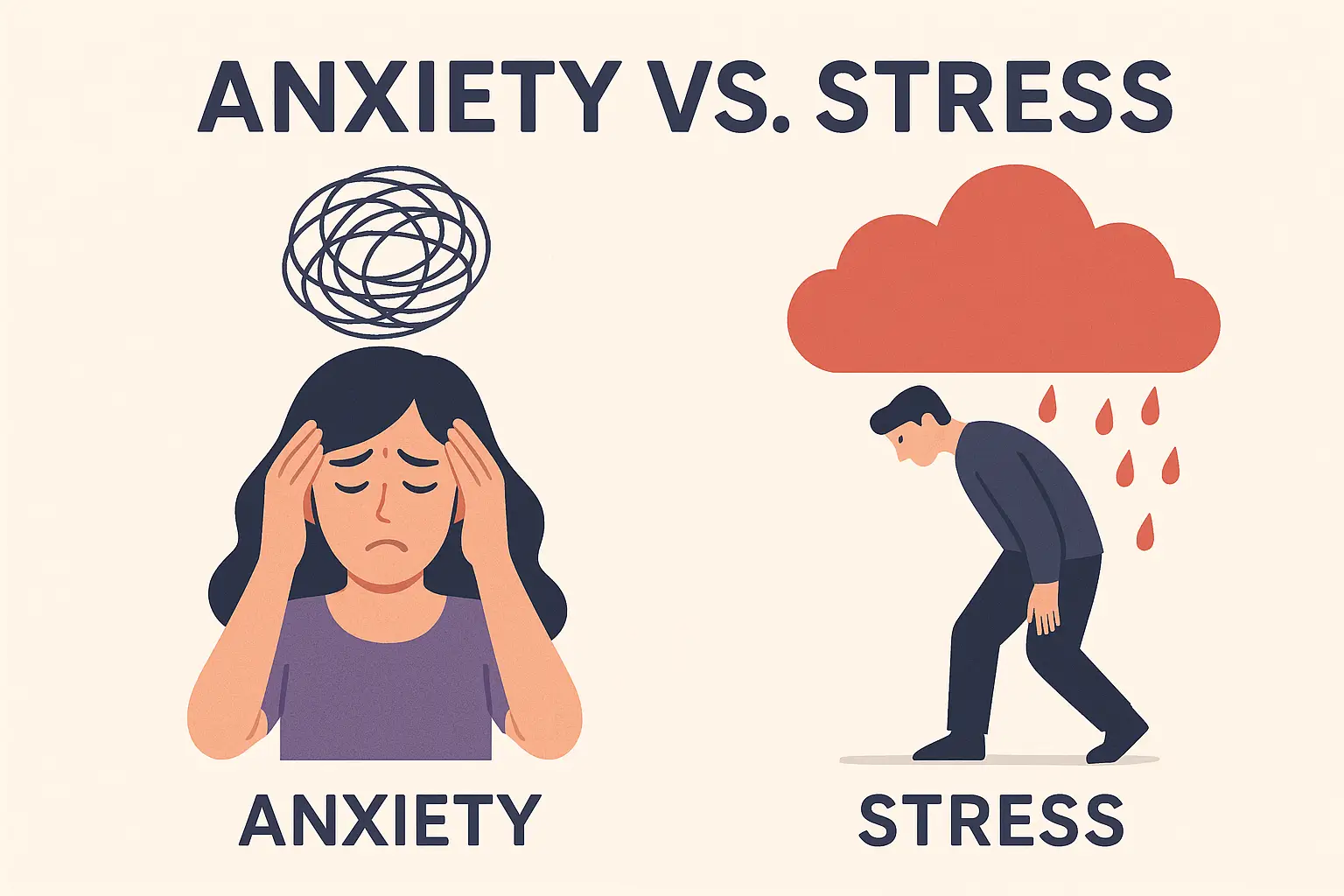
Anxiety vs stress come up in the same sentence so often that most people treat them as the same problem. That’s understandable — both can disrupt sleep, tighten your chest, and make your mind hard to quiet. But they’re not the same, and the difference matters when you’re deciding what to do about it.
Anxiety vs Stress: The Real Difference
Stress is a response to something external. A work deadline, a difficult conversation, a financial problem — your body activates to meet a specific demand. When that demand is gone, the stress typically goes with it. That’s the system working correctly.
Anxiety is different. It’s internal, and it persists even when the external situation has resolved — or when there’s no clear situation at all. Anxiety doesn’t need a trigger. It generates its own. That’s what makes it resistant to advice like “just relax” or “try to unwind.” Those approaches can reduce stress. They don’t address what’s driving anxiety.
The Anxiety and Depression Association of America estimates that anxiety disorders affect more than 40 million adults in the United States — the most common mental health condition in the country. Many of those people spent years telling themselves they were just stressed.
How Stress Shows Up in the Body
The physical symptoms of stress are usually tied to a specific trigger and tend to ease when that trigger does. Headaches, muscle tension, tight shoulders, trouble sleeping before a high-stakes event, a shorter fuse than usual — these are normal responses to pressure. The nervous system is mobilizing for something it perceives as a threat, and once that threat passes, it settles.
Chronic stress is a different situation. When the pressures don’t let up — when it’s not one deadline but a relentless state of demand — the body stays in that activated state. Over time, the American Psychological Association has documented links between chronic stress and high blood pressure, immune dysfunction, and significantly increased risk of depression and anxiety disorders. Stress that never turns off is not just uncomfortable. It’s physiologically damaging.
What Anxiety Feels Like When There’s No Clear Trigger
People with anxiety often describe a particular frustration: they can’t point to what’s wrong. Life looks manageable from the outside. Internally, something feels persistently off regardless of what’s happening around them.
Common anxiety symptoms include worry that feels out of proportion to the situation, racing thoughts that intensify at night, automatic worst-case thinking, restlessness that doesn’t resolve with rest, and physical symptoms — racing heart, dizziness, shortness of breath — that have no medical explanation. The nervous system is treating an internal threat as if it’s a real external danger. The body doesn’t know the difference.
Generalized Anxiety Disorder, Panic Disorder, and Social Anxiety Disorder are among the most common presentations I see in practice. Each has a distinct profile, but they share one feature: a nervous system stuck in threat-detection mode even when no immediate threat is present.
How Anxiety vs Stress Play Out Day to Day
Stress says: “I have too much to handle right now.” Anxiety says: “Something bad is going to happen, and I need to stay alert.” Stress is situational. Anxiety is anticipatory.
With stress, there’s usually a clear problem, and relief comes when the problem is solved. With anxiety vs stress, the difference shows up after the problem is solved — stress fades, anxiety often doesn’t. The nervous system has already moved on to the next potential threat. The goal post shifts. That’s one of anxiety’s defining features, and one of the reasons people with anxiety feel exhausted even when nothing obvious is wrong.
This distinction matters when you’re figuring out what to do. Coping strategies that reduce stress — consistent exercise, better sleep, healthier boundaries — can ease anxiety symptoms somewhat. But they don’t resolve an anxiety disorder. That usually requires more targeted clinical work. anxiety vs stress responds well to the right kind of clinical support.
When Stress Becomes Something More
Prolonged, unmanaged stress doesn’t just wear you out. It can trigger anxiety disorders in people who are already predisposed to them. Sustained activation of the stress response sensitizes the nervous system over time, making it more reactive and harder to settle back down. anxiety vs stress doesn’t have to be permanent.
If you’ve been under extended pressure and you notice that the worry doesn’t stop when the stressor does — or that new fears keep replacing old ones — that’s worth taking seriously. It’s a signal that something has shifted from situational stress into a pattern that stress management alone won’t fix. If you’re exploring help for anxiety vs stress, a free consultation is a good place to start.
5 Proven Coping Strategies for Both
Diaphragmatic breathing. Slow, deliberate breaths activate the parasympathetic nervous system — the system responsible for signaling to the body that the threat has passed. Even a few minutes of intentional breathing changes your physiological baseline over time. It’s not a relaxation trick. It’s a direct input into the nervous system’s threat-response circuit.
A simple starting point: inhale for four counts, hold for four, exhale for six. The longer exhale is what drives the shift. Most people find that five minutes of this in the morning — before the day has a chance to activate the stress response — makes everything else easier to manage. Working with a therapist who understands anxiety vs stress makes a concrete difference.
Consistent movement. Exercise reduces cortisol, improves sleep quality, and gives the nervous system a way to discharge the physical tension that both anxiety and stress generate. Walking, yoga, and cycling are all effective. The type matters less than the consistency. One thing I notice with anxious clients: the days they most need to move are often the days the anxiety makes starting feel impossible.
That resistance is worth pushing through. Even a 20-minute walk at low intensity produces measurable changes in mood and nervous system activation — you don’t need an intense workout for the effect to be real. anxiety vs stress remains one of the most effective conditions to work with in therapy.
Sleep as a priority, not an afterthought. Anxiety and stress both worsen significantly with poor sleep, and both make sleep harder to get. Consistent schedule, limited screens before bed, a dark and cool room — these aren’t minor tweaks. Sleep is usually one of the first things I address with new clients, because everything else is harder when it’s broken. Racing thoughts at 2 a.m. are often anxiety doing what anxiety does, not just a restless mind. Treating the sleep problem without treating the anxiety rarely holds. The two need to be addressed together. anxiety vs stress is something therapy can directly address.
Talk therapy. Cognitive-behavioral therapy is one of the most well-researched approaches for anxiety and stress-related conditions. It helps identify the thinking patterns that keep the threat response active and builds tools for interrupting them. For anxiety with trauma underneath it, EMDR therapy can address the root more directly than CBT alone.
CBT for anxiety isn’t just talking about your problems — it’s structured work on the specific automatic thoughts and avoidance behaviors that maintain the anxiety cycle. Most clients see meaningful change within 8–12 sessions, though that varies significantly depending on history and what we’re working with. anxiety vs stress is far more common than most people realise.
Honest self-assessment. Stress often responds to lifestyle changes. If you’ve made real effort on that front and the anxiety persists, that’s information — not a personal failure. It means you’re dealing with something that needs more specific clinical support than self-help can provide. The most common pattern I see: someone has been managing well enough for years, then a major stressor tips the balance and the anxiety doesn’t reset once the stressor is gone. If that sounds familiar, a clinical assessment isn’t a dramatic step. It’s just getting an accurate read on what you’re working with so you can do something useful about it. anxiety vs stress responds well to the right kind of clinical support.
When It’s Time to Get Help for Anxiety vs Stress
The line worth watching: when symptoms start interfering with your daily life, your relationships, or your ability to work, self-management isn’t enough. That’s not a failure. It’s an accurate read of what the situation calls for. anxiety vs stress doesn’t have to be permanent.
Specific signs it’s time to reach out: worry you can’t control despite real effort, panic attacks, avoiding situations because of fear, physical symptoms with no medical explanation, or a persistent sense of dread that doesn’t connect to anything specific. If you’re exploring help for anxiety vs stress, a free consultation is a good place to start.
If you’re in Tampa and you’re not sure whether what you’re experiencing is stress or something more, that’s exactly what an anxiety therapy assessment is designed to sort out. I work with both. The starting point is just getting an accurate picture of what you’re dealing with. Working with a therapist who understands anxiety vs stress makes a concrete difference.
Ready to Talk?
Most people who reach out to me about anxiety vs stress have been carrying it longer than they needed to. Individual therapy is one of the most direct ways to figure out what’s going on and start building tools that actually hold — not just strategies for getting through the day, but real change in how your nervous system responds.
If you’re ready to get started, schedule a free consultation. We’ll figure out what you’re dealing with and where to go from there. anxiety vs stress remains one of the most effective conditions to work with in therapy.
Ready to get support? schedule a free consultation at Now & Zen Wellness in Tampa.
Ready to get support? individual therapy at Now & Zen Wellness in Tampa.