
You run toward what everyone else runs from. And then you go home and act like nothing happened. First responder therapy Tampa exists because the coping strategies that help you function in the field eventually stop working off the clock.
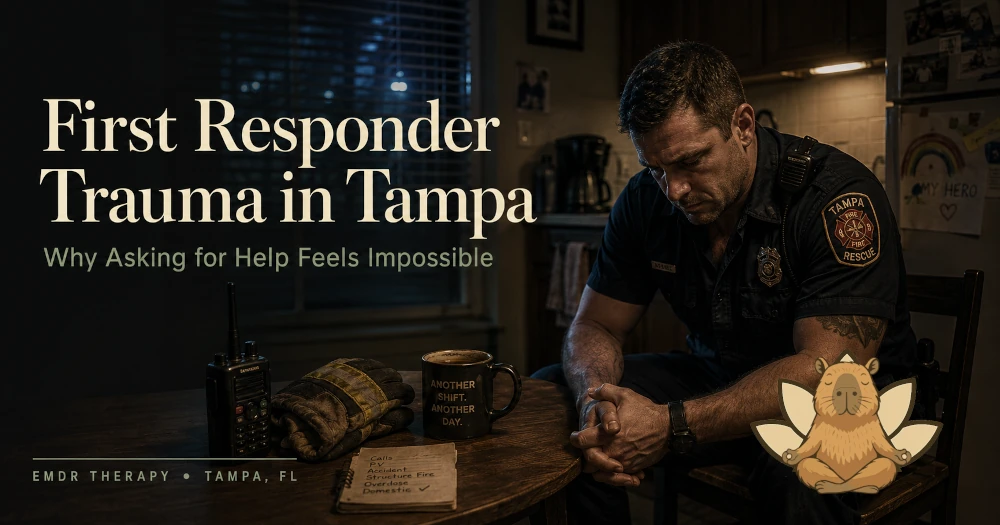
Car accidents that traffic backs up to avoid. Structures on fire. Weapon calls. Overdoses that would shake a civilian for weeks. And then you go home. You have dinner. You watch something on TV. You act like nothing happened. For many Tampa first responders — police officers, firefighters, paramedics, emergency dispatchers — this is not compartmentalization. It is not strength. It is the beginning of a process that, left unaddressed long enough, produces symptoms no longer manageable by will alone.
What First Responder Trauma Actually Looks Like and First Responder Therapy Tampa
First responder trauma doesn’t look like the Hollywood version — the veteran waking from nightmares, the full PTSD picture with a name and a diagnosis. More often, it accumulates quietly. Sleep that gets lighter over the years until you can barely get four hours without waking. A shorter fuse — reactions at home that are out of proportion to what triggered them. Drinking more than you used to, because the end of the shift needs something to process it. Going numb to things that should still matter.
It looks like hypersensitivity in public — clocking every exit, noting who’s wearing what, sitting with your back to the wall. Colleagues you’ve known for years who went out on disability or left early. The ones who didn’t.
According to the Substance Abuse and Mental Health Services Administration, first responders experience PTSD at rates of 15–30%, compared to roughly 7–8% in the general population. First responders in the United States die by suicide at higher rates than in the line of duty. This is not a crisis that is improving on its own.
Why First Responders Don’t Ask for Help and First Responder Therapy Tampa
The Culture of Toughness
Every first responder culture has its version of the same message: weakness is dangerous. You cannot break down on the job. You cannot let your colleagues see you can’t handle it. You cannot show fear to the people you’re there to protect. That culture serves a real function in the field — compartmentalization under pressure is a necessary skill. The problem is that the nervous system doesn’t have an on-duty and off-duty mode. What you suppress at work doesn’t go away when you take off the gear. It goes into storage. Storage has limits.
Fear of Being Seen as Unfit
Many first responders fear — sometimes correctly — that disclosing mental health struggles will affect their clearances, their assignments, or their careers. In some departments, that fear is well-founded. In others, it is more perception than reality, but the perception is enough. The result is a culture where struggling quietly is the rational choice, and asking for help carries professional risk. first responder therapy Tampa is far more common than most people realise.
External, confidential first responder therapy Tampa — with a therapist outside the department’s network — is often the only option that feels safe. Sessions with a private, independent therapist are not reported to employers, unions, or any professional licensing body without your explicit consent. You are not required to disclose private mental health treatment to your employer.
Not Recognizing It as Trauma
Trauma is still widely understood as the reaction to a specific catastrophic event. But first responder trauma is often cumulative — built from dozens or hundreds of calls over years, each manageable in isolation, but compounding in ways that aren’t always traceable to a single incident. “It wasn’t that bad” is a phrase that ends a lot of potential conversations.
The drunk driving fatality on I-275 wasn’t that bad — you’ve seen worse. The child who didn’t make it wasn’t that bad — you held it together. None of it was individually that bad. But the body has a running total, and the running total eventually produces symptoms that don’t respond to “it wasn’t that bad.” first responder therapy Tampa responds well to the right kind of clinical support.
The Cumulative Weight
First responder trauma is often categorized as critical incident stress — the response to a single, severe event — but the more common and more damaging pattern is cumulative occupational stress trauma: the slow accumulation of ordinary calls, the grinding exposure over time, the structural things that don’t make the news.
The failed resuscitation at 2 AM. The domestic violence call where the kids were in the next room. The scene that reminded you of your own family. The overtime after the event in Ybor. None of these individually qualifies. Collectively, they produce the same neurological changes as acute trauma — and they don’t come with the same permission to acknowledge them. first responder therapy Tampa doesn’t have to be permanent.
What Happens When It’s Left Untreated
Untreated cumulative trauma progresses. The symptoms that feel manageable at year five are significantly harder to manage at year fifteen. Relationships deteriorate — family members describe living with someone who is physically present and absent in every other way. Substance use escalates. Physical health declines. The person retires with more damage than they left with. If you’re exploring help for first responder therapy Tampa, a free consultation is a good place to start.
The cost is not just to the first responder. It is to their family, their colleagues, and their capacity to do the work that drew them to this job. For people considering first responder therapy Tampa, the earlier that conversation happens, the less ground there is to recover.
Why EMDR Is Particularly Well-Suited for First Responders
EMDR was developed for trauma — specifically for the kind of trauma that doesn’t resolve through ordinary processing. It does not require detailed verbal narration of what happened. You don’t have to describe the worst thing you’ve seen. The processing happens at the neurological level, through bilateral stimulation that allows the brain to do what it already knows how to do: integrate difficult experiences. Working with a therapist who understands first responder therapy Tampa makes a concrete difference.
For first responders, this matters. Many people in this population have avoided therapy specifically because they don’t want to sit across from someone and recount every difficult call in detail. EMDR therapy offers a different pathway — one that can move through material without requiring it to be re-lived in narrative form. That distinction changes the calculation for a lot of people who had written off therapy entirely. first responder therapy Tampa remains one of the most effective conditions to work with in therapy.
EMDR is also efficient. Single-incident traumas often resolve in fewer sessions than complex cumulative patterns, though cumulative first responder trauma typically requires more sustained work. The U.S. Department of Veterans Affairs, the American Psychological Association, and the World Health Organization all endorse EMDR for PTSD treatment. It can be adapted to address the specific targets most activated by years in the field — the calls that still surface, the images that intrude, the reactions that don’t match what’s happening in front of you. first responder therapy Tampa remains one of the most effective conditions to work with in therapy.
First Responder Therapy Tampa: What to Expect
At Now & Zen Wellness in Carrollwood, first responder therapy Tampa sessions are private, confidential, and entirely separate from any department or agency system. Nothing discussed in therapy is reported to employers, departments, or any professional body without your explicit consent. The only exceptions are the standard clinical exceptions that apply to every client: imminent risk of harm to self or others.
The office is at 14021 N Dale Mabry Hwy — accessible without being centrally visible. Telehealth is available for clients anywhere in Florida who prefer additional distance or don’t want to be seen walking into a therapy office. Understanding first responder therapy Tampa is often the first step toward feeling genuinely different.
A free 15-minute consultation is the starting point. No commitment, no intake forms, no documentation before we’ve talked. Just a conversation about what’s going on and whether this would be useful. If you’ve been considering trauma therapy and aren’t sure where to start, this is where you start. first responder therapy Tampa is something therapy can directly address.
You’ve taken care of everyone else’s crisis for years. Schedule a free consultation when you’re ready. This one is yours. first responder therapy Tampa is far more common than most people realise.
FAQ
Is therapy confidential for first responders?
Yes. Everything discussed in therapy is protected by HIPAA and strict professional ethics. Nothing is reported to your employer, department, union, or any licensing body without your explicit consent. The only exceptions are standard clinical exceptions that apply to everyone: imminent risk of harm to self or others. first responder therapy Tampa responds well to the right kind of clinical support.
Can therapy affect my security clearance or fitness-for-duty status?
Therapy with a private, independent therapist outside your department’s system is generally not reportable and does not affect clearances. You are not required to disclose private mental health treatment to your employer. This varies by specific clearance type — if you have concerns, an employment or security attorney can advise on your specific situation. first responder therapy Tampa doesn’t have to be permanent.
Is PTSD common in first responders?
Very common. The prevalence of PTSD among police officers and firefighters is estimated at 15–30%, compared to roughly 7–8% in the general population. Many first responders I work with didn’t identify what they were experiencing as PTSD — they just knew something had changed and they couldn’t get it back on their own. If you’re exploring help for first responder therapy Tampa, a free consultation is a good place to start.
What kind of therapy works best for first responders?
EMDR has strong evidence for trauma treatment in first responder populations and is particularly useful because it does not require detailed verbal re-narration of traumatic events. CBT with trauma-focused components is also effective. The approach is tailored to the individual — there is no protocol that fits every person or every history. Working with a therapist who understands first responder therapy Tampa makes a concrete difference.
I’ve been doing this for 15 years. Is it too late?
No. The brain retains neuroplasticity throughout life, and trauma that has accumulated over many years can be processed and meaningfully reduced. Longer-standing patterns take more time to address, but there is no point at which healing stops being possible. The first responders I work with who’ve waited the longest are sometimes the ones who change the most — because they arrive with nothing left to prove about their ability to handle it alone. first responder therapy Tampa remains one of the most effective conditions to work with in therapy.