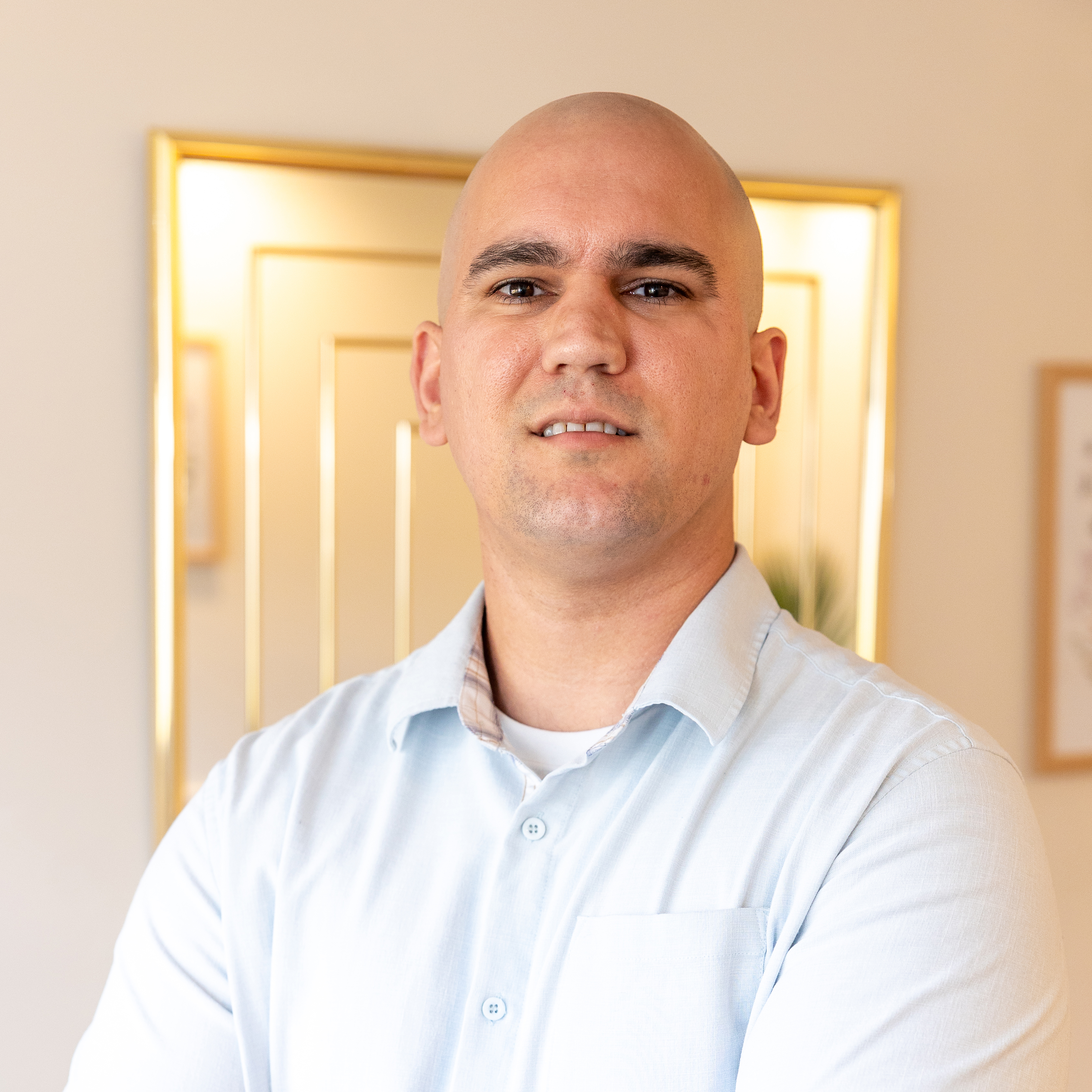
I'm Douglas.
Let's get to work.
Good therapy doesn't feel like being analyzed. It feels like finally having a space where you can be honest — and someone who will be honest back.
Not just a therapist.
A straight-shooter.
I'm Douglas Carmody, a Licensed Clinical Social Worker and the owner of Now & Zen Wellness in Tampa's Carrollwood area. I work with adults who are dealing with anxiety, trauma, depression, relationship struggles, and questions about who they want to be — and I work with couples who want to stop having the same fight on repeat.
My clinical background has taken me into some demanding environments — working with individuals on federal probation, running recovery-focused groups, and supporting people navigating some of the hardest transitions of their lives. That experience shaped how I practice. I don't sugarcoat. I also don't lecture. I believe most people already know something has to change — they just need the right support to figure out how.
Men's mental health is an area I'm particularly drawn to. Many of the men I work with have never had a space where they felt safe being straightforward about what's actually going on. I try to be that space — no jargon, no posturing, just direct and honest conversation that leads somewhere.
I lead therapy groups as well, including recovery-focused groups where the goal isn't just sobriety — it's building structure, direction, and a life worth staying sober for.
Therapy that's actually useful.
Sessions with me are direct, collaborative, and grounded in what works. I draw from several evidence-based approaches — not because they're trendy, but because they produce real results. You'll leave most sessions with something concrete you can apply before you come back.
Present & Practical
We don't just talk about your past indefinitely. We work on understanding it so it stops running the show — then we build practical skills for the life you're actually living right now.
Honest, Not Harsh
I'll challenge you when it serves you — not to be contrarian, but because the most useful thing I can do is tell you the truth with care. You won't be talked down to or given a script. You'll be heard and met where you actually are.
Trauma-Informed
Everything I do is grounded in an understanding of how trauma shapes the nervous system, relationships, and self-perception. If you've been carrying something for a long time, we can work through it at a pace that feels safe.
You might be a good fit if you're any of these.
I work with adults ages 18 to 75 — individuals and couples — who are ready to do something different. I'm not the right fit for everyone, and that's okay. But if any of the following sound familiar, we should probably talk.
- You feel stuck — like you keep ending up in the same situations no matter what you try
- Anxiety or overwhelm is making it hard to function, sleep, or feel present
- You've been through something difficult and it's still affecting you, even years later
- You and your partner love each other but can't seem to stop hurting each other
- You're in recovery or working to change your relationship with substances
- You've never quite felt like therapy was built for someone like you
- You're ready to stop managing symptoms and actually change something
"My goal isn't to help you cope better with a life that isn't working. It's to help you build one that does."— Douglas Carmody, LCSW
Reaching out is the hardest part.
It can feel uncomfortable to contact a therapist for the first time. That's completely normal — and it doesn't mean something is wrong with you. It means you're considering doing something that takes real courage. The consultation is free, low-pressure, and just a conversation. You don't have to have everything figured out before you reach out.
In-person in Carrollwood / Tampa, FL · Telehealth across Florida · Mon–Fri 10am–7pm