Panic Attacks at Work: What to Do When Anxiety Hits in the Office
September 27, 2025·By Douglas Carmody·9 min read
Racing heart. Tunnel vision. The certainty that something is very wrong. Panic attacks at work can feel career-ending. Here's what to do when anxiety hits — and what it means for treatment.
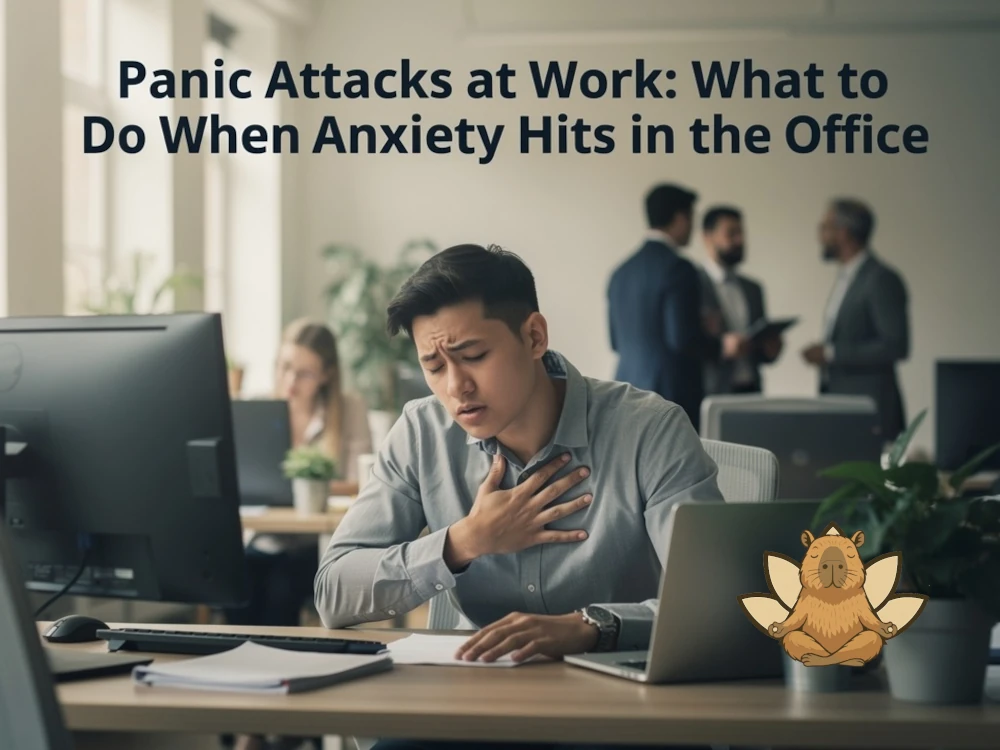
A panic attack at work is one of the most disorienting experiences a person can have — and it’s far more common than most people realize. It started in a meeting. Or at your desk. Or walking into the building and suddenly your heart was going and you couldn’t fully breathe and the walls felt like they were moving slightly and you were absolutely certain something was very wrong.
You excused yourself. Went to the bathroom. Waited for it to pass. Told yourself you were fine.
But now you’re going into every meeting wondering if it will happen again. You’ve started avoiding certain situations. Your job feels different — shadowed by something you can’t explain to anyone.
Panic attacks at work are more common than most people realize, and more treatable than the experience suggests in the moment. Here’s what’s actually happening, what to do about it in real time, and what seeking help actually looks like.
What’s Actually Happening During a Panic Attack and Panic Attack At Work
A panic attack is not a heart attack, though the physical experience can be indistinguishable from one. It is a sudden activation of the sympathetic nervous system — the fight-or-flight response — in the absence of an actual threat.
Your brain has misread something as dangerous. Maybe it was a tone in someone’s voice. A facial expression. The physical sensation of being in a closed room. The deadlines piling up. The amygdala — the brain’s alarm center — fires, and the body follows: adrenaline floods the system, heart rate spikes, breathing becomes shallow, blood flows away from your extremities and toward your major muscles, and your vision narrows to help you focus on the threat.
The problem is there’s no threat to run from or fight. The alarm is accurate about its own activation; it’s wrong about what triggered it.
Most panic attacks peak at about 10 minutes and resolve within 20–30 minutes. This does not make them less terrifying. But it does mean something important: the physical experience, however convincing, is not what it feels like. You are not dying. You are not going crazy. Your nervous system is misfiring.
Why Work Triggers Panic Attacks and Panic Attack At Work
Work concentrates several of the most reliable anxiety activators in one place:
Evaluation and judgment. Performance reviews, presentations, team meetings — the ongoing experience of being watched and assessed. For people with social anxiety or perfectionism, this creates a continuous low-grade threat signal.
Loss of control. Tight deadlines, unpredictable bosses, shifting priorities, organizational chaos — environments where you can’t predict what’s coming activate the same nervous system that evolved to handle physical unpredictability.
Physical confinement. Crowded offices, small conference rooms, open-plan spaces with nowhere to go — for people with a history of trauma or claustrophobia, these spaces can trigger the alarm before anything specific happens.
Performance pressure accumulation. Sometimes it isn’t one thing. It’s months of everything building until the nervous system runs out of capacity to absorb more. A relatively neutral moment becomes the trigger simply because it was the last thing added.
What to Do In the Moment and Panic Attack At Work
Step 1: Get Out of the Spotlight
If you’re in a meeting or a visible situation, excuse yourself. “I need a moment” is enough. You do not owe anyone an explanation. The bathroom, a stairwell, or outside are all good.
The goal is to reduce environmental input so your nervous system has fewer things to process simultaneously.
Step 2: Ground Your Body
Pick one or more of these and use it:
5-4-3-2-1: Name 5 things you can see, 4 you can touch, 3 you can hear, 2 you can smell, 1 you can taste. This pulls your attention into the present moment and out of the internal alarm spiral.
Cold water: Splash cold water on your face or hold your wrists under cold water. This activates the dive reflex — a parasympathetic response that slows the heart rate and helps interrupt the panic cycle.
Press your feet into the floor. Feel the pressure of solid ground beneath you. This sounds almost too simple — it works.
Step 3: Breathe Into the Panic, Not Away from It
The instinct is to try to breathe faster. This backfires. Hyperventilation lowers CO₂ and increases panic symptoms.
Instead: slow the exhale. Breathe in for 4 counts, out for 6–8. A longer exhale activates the parasympathetic nervous system — the brake rather than the accelerator. You don’t need to be doing box breathing perfectly. You just need to make the out-breath longer than the in-breath. panic attack at work is far more common than most people realise.
Step 4: Remind Yourself What’s Actually True
“This is a panic attack. It will peak and pass. I am not in danger. My nervous system is misfiring. This will be over in less than 30 minutes.” panic attack at work responds well to the right kind of clinical support.
This is not positive thinking. It is accurate information being delivered to the part of the brain that has lost access to accurate information. Say it like you mean it — because it’s true. panic attack at work doesn’t have to be permanent.
After the Panic Attack: What Comes Next
Once the acute episode passes, you’ll often feel exhausted — drained in the way that a burst of adrenaline leaves you. Give yourself a few minutes before jumping back in. If you’re exploring help for panic attack at work, a free consultation is a good place to start.
If it’s possible, step outside or sit somewhere quiet before returning to work. The nervous system needs a buffer.
Resist the urge to suppress what happened. Acknowledge it to yourself — “That happened. It passed. I’m okay.” Suppression tends to increase vigilance around the next potential panic, which increases the likelihood of one. Working with a therapist who understands panic attack at work makes a concrete difference.
When Work Panic Is a Pattern
A single panic attack may not indicate a disorder. But if any of the following are true, it’s worth addressing with a professional: panic attack at work remains one of the most effective conditions to work with in therapy.
– You’ve had multiple panic attacks in work settings- You’re organizing your schedule around avoiding situations where panic might happen- You’re spending significant mental energy worrying about the next episode- You’ve noticed panic or high anxiety in your body even when nothing has happened yet If you’re exploring help for panic attack at work, a free consultation is a good place to start.
This pattern is called anticipatory anxiety, and it’s one of the main ways panic disorder becomes self-perpetuating. The fear of the panic becomes more debilitating than the panic itself. Working with a therapist who understands panic attack at work makes a concrete difference.
Should You Tell Your Employer?
This is a genuinely personal decision and there is no universal right answer.
You are not legally required to disclose a mental health condition to your employer. In most situations, it is not advisable to disclose during an acute phase, because disclosure before you have a plan or support in place can create complicated dynamics. panic attack at work remains one of the most effective conditions to work with in therapy.
If your work performance is being affected and you need accommodation — remote work, schedule flexibility, less travel — the ADA may provide a path for requesting this without detailed disclosure. An HR professional or employment attorney can advise you specifically. Understanding panic attack at work is often the first step toward feeling genuinely different.
What is always advisable: telling your therapist. Getting this addressed directly.
Anxiety and Panic Disorder Treatment in Tampa
At Now & Zen Wellness in Carrollwood, Tampa, panic disorder and work anxiety are among the most common reasons people seek individual therapy. Treatment is active and direct. panic attack at work is something therapy can directly address.
Cognitive Behavioral Therapy addresses both the thoughts that feed the panic cycle and the avoidance behaviors that sustain it. Exposure work — graduated, controlled, conducted at your pace — helps rebuild the relationship with feared situations without the alarm. EMDR is useful when the anxiety has roots in earlier experiences that the nervous system is still responding to. panic attack at work is far more common than most people realise.
Most people with panic disorder experience meaningful improvement within 8–12 sessions. It doesn’t have to keep organizing your life.
In-person sessions are available at the Carrollwood office. Telehealth is available throughout Florida.
FAQ
Q: Is a panic attack at work dangerous?
A: No. Panic attacks feel dangerous — the physical experience can closely resemble a cardiac event — but they are not medically dangerous. If you’re uncertain whether you’re experiencing a panic attack or a medical emergency, seek medical evaluation first. panic attack at work responds well to the right kind of clinical support.
Q: How do I stop a panic attack quickly?
A: The most effective in-the-moment interventions are grounding techniques (5-4-3-2-1, cold water), controlled breathing with a longer exhale, and accurate self-talk about what’s happening. The goal is to interrupt the adrenaline loop without fighting the panic, which tends to amplify it. panic attack at work doesn’t have to be permanent.
Q: Can therapy cure panic attacks?
A: Panic disorder is highly treatable. CBT, particularly with exposure components, has one of the strongest evidence bases in all of mental health treatment. Most people with panic disorder experience significant or complete symptom resolution with appropriate treatment. If you’re exploring help for panic attack at work, a free consultation is a good place to start.
Q: Will my panic attacks go away on their own?
A: Sometimes. Isolated panic attacks triggered by a specific stressor can resolve when the stressor does. But panic disorder — with its pattern of recurrence and anticipatory anxiety — tends to persist and worsen without treatment. Working with a therapist who understands panic attack at work makes a concrete difference.
Q: How is panic disorder different from general anxiety?
A: Panic disorder involves recurrent, unexpected panic attacks and significant worry about future episodes. Generalized anxiety disorder involves persistent worry across multiple domains without necessarily involving panic attacks. Many people have elements of both, and treatment addresses both. panic attack at work remains one of the most effective conditions to work with in therapy.