
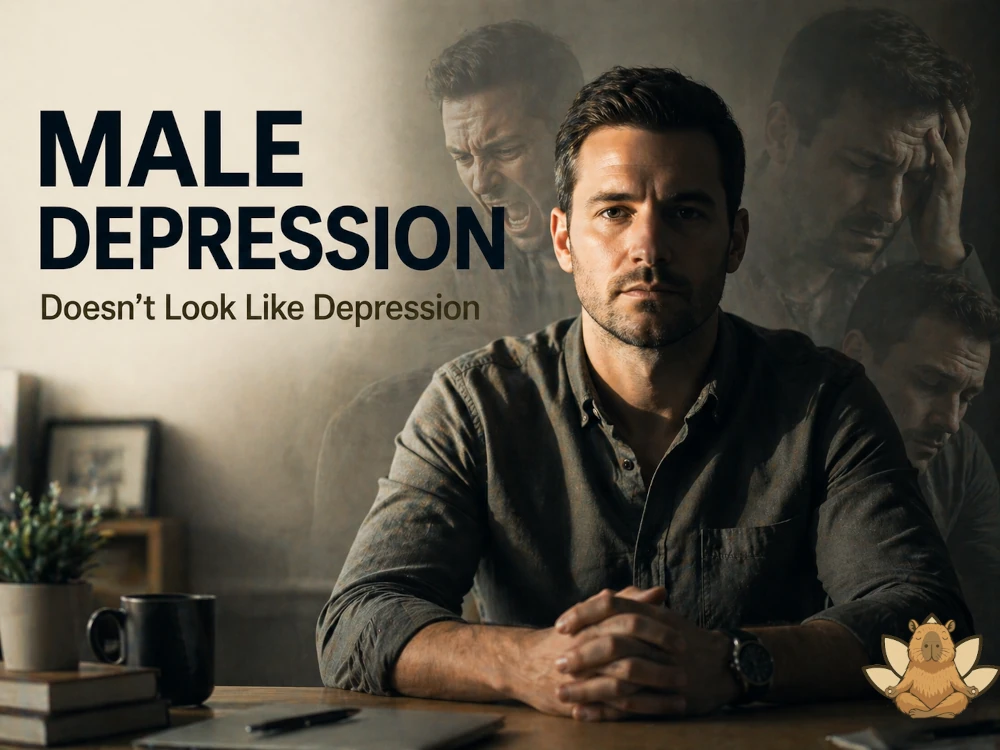
Male depression usually doesn’t look like what people picture. No crying, no staying in bed, no obvious sadness. It looks like a guy who seems fine — but hasn’t actually felt fine in months.
What depression actually is and Male Depression Symptoms
It’s not a mood problem or a motivation problem. Depression is a dysfunction in the brain’s systems for regulating mood — serotonin, dopamine, norepinephrine. Not a character flaw. Not something you can push through with enough discipline. The research on CBT and EMDR is solid — not “promising,” actually solid. Most men I’ve worked with notice something shifting within the first 8 to 10 sessions. Not resolved, but different.
How it actually shows up and Male Depression Symptoms
Irritability and anger. Probably the most commonly missed one. Men can be snapping at people, running on low-grade frustration that doesn’t attach to anything specific, and never connect it to depression — because anger is socially acceptable in a way that sadness isn’t. The brain finds a different exit.
Overworking. Work is where you don’t have to feel anything, which is exactly why it gets worse. You stay busy enough that nothing surfaces, and then at some point even the busyness stops working. Taking a day off feels awful. Just sitting still is out of the question.
Substance use. Alcohol and cannabis, mostly. They work short-term. That’s the problem. Self-medicating keeps the depression from surfacing long enough to cause real damage before anyone notices — including the person doing it. If substance use has become part of the pattern, that’s worth addressing directly.
Present in body, absent in everything else. Partners usually catch this one before the man does. He’s at dinner. He’s at the kids’ events. Physically present — but there’s nothing behind it. Flat. Somewhere else. Going through the motions.
Physical symptoms without a physical cause. Men who don’t have much language for their emotional state tend to lead with their bodies. A stomach that won’t settle. Back pain that came from nowhere. Headaches, fatigue, exhaustion that sleep doesn’t fix. If you’ve been through rounds of appointments and nothing explains it, depression is worth looking at.
Risk-taking. Speeding. Bad financial decisions. Picking fights that don’t need to happen. It’s not random. When you’re numb long enough, you start doing things that force a reaction — anything to get out of the flatness. Adrenaline works, at least for a minute.
Losing interest in what used to matter. Not dramatic. Just quiet. The hobbies become chores. The things you’d actually look forward to now feel like obligations. You do them, but you’re not there when you do.
Why it goes undiagnosed and Male Depression Symptoms
Men are often taught early that feelings are weakness, so by adulthood the suppression is automatic — it doesn’t feel like suppression anymore, it just feels like normal. Most men picture depression as visible collapse — missing work, not getting off the couch. So if you’re functional, you figure you’re fine, or fine enough. And asking for help carries its own problem: it can feel like it disproves everything you thought was true about yourself.
What happens when it goes untreated
Relationships erode. Substance use escalates. Physical health deteriorates. The suicide statistics are worth knowing: men die by suicide at nearly four times the rate of women — mostly because recognition takes longer and treatment starts later.
What therapy actually looks like
In my practice in Tampa, I work with men who want structure — a clear problem, a clear approach. CBT is good at untangling the thinking patterns that feed depression. When someone’s pulled back from everything, Behavioral Activation helps get traction back. If there’s something earlier driving it, EMDR can get there — it’s one of the best-researched treatments for trauma-rooted depression.
On asking for help
Depression lies about how stuck you are. The sense that nothing will change isn’t clarity — it’s a symptom. It’s not an accurate read of your situation. Getting help isn’t admitting defeat — it’s recognizing that something in your brain chemistry is off and that there are effective ways to fix it. Reach out if you want to talk about what that looks like.
What to Expect When Working on Male Depression Symptoms in Therapy
Many people come in not knowing what to expect from therapy around male depression symptoms. The short answer: you won’t be pushed to talk about things before you’re ready, and you won’t be handed a list of affirmations and sent home. Real work on male depression symptoms involves building awareness of the patterns — when they show up, what triggers them, what they’re protecting you from — and then slowly building a different response.
The first few sessions are mostly about getting a clear picture of what’s actually going on. Male Depression Symptoms rarely exists in isolation. It usually connects to something deeper — a history, a pattern of relationships, a learned way of coping that made sense at some point and now doesn’t. Therapy creates the space to look at that connection directly.
Progress isn’t always linear. Some weeks things feel clearer; others, something gets stirred up and you leave feeling worse before you feel better. That’s normal. It usually means you’re getting closer to something real. What changes over time is your relationship to male depression symptoms — not just your ability to manage it, but your understanding of where it comes from and why it still shows up.

Understanding Male Depression
The Importance of Recognizing Male Depression
Understanding the signs and impacts of male depression can lead to better outcomes for men suffering in silence. Understanding male depression symptoms is what brings many people to therapy.
Ready to get support? schedule a free consultation at Now & Zen Wellness in Tampa.
Ready to get support? individual therapy at Now & Zen Wellness in Tampa.