
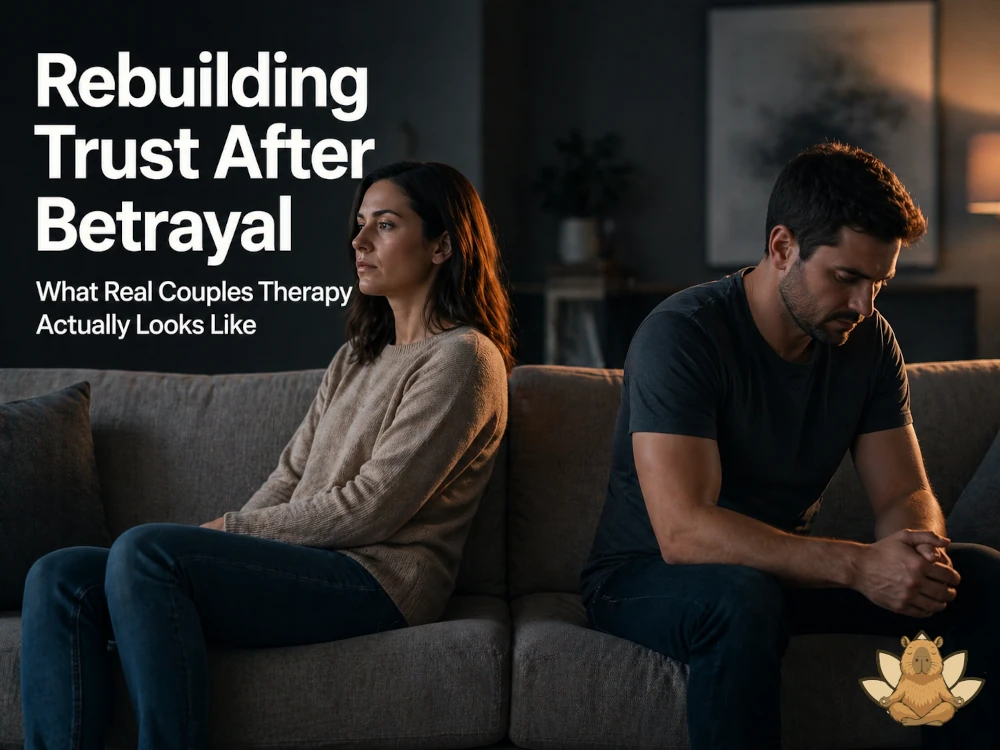
You want to stay. You also can’t stop seeing it. Couples therapy after infidelity in Tampa deals with something specific: relational trauma. What most people call a betrayal is also a psychological injury to the attachment between two people, and the work that follows reflects that. That image. That moment you found out. Understanding rebuilding trust after betrayal is what brings many people to therapy. Couples Therapy After Infidelity Tampa is a topic that comes up often in therapy.
The story you’ve replayed so many times you’ve lost count, each time hoping it will feel less true, and each time it doesn’t. What betrayal breaks is harder to name than the event itself. The assumption that you knew this person. That you were safe. That the picture you had of your life was accurate.
All of it goes up for question at once. When that happens, the question most people think they’re facing — “do I stay or go?” — turns out to be the wrong one. The harder question underneath it: what is actually true here, and is any of it worth saving? Couples therapy doesn’t answer those questions for you. It creates the conditions in which you can answer them yourself — together, if that’s where you end up. rebuilding trust after betrayal remains one of the most effective conditions to work with in therapy.
What betrayal does to a relationship and Rebuilding Trust After Betrayal and Couples Therapy After Infidelity Tampa
Infidelity isn’t primarily a sexual event. Clinically it’s a relational trauma, and the partner who was betrayed often experiences it with symptoms that closely resemble PTSD: intrusive thoughts, hypervigilance, a numbness that comes and goes, trouble believing their own read of the situation.
“If I didn’t see this coming, what else don’t I know?” That question is legitimate, and it makes normal functioning temporarily impossible.The need for closeness and the inability to tolerate it coexist. Every answer the betraying partner gives either doesn’t fully satisfy or opens three more questions. This is a predictable response to a specific kind of injury, not a character flaw. The partner who betrayed is in a different kind of pain: shame, the terror of losing the relationship, the disorientation of having kept something significant hidden for a long time, and often some unresolved pain of their own that contributed to the situation — not as an excuse, but as context. Neither person is fine. And both need things the other genuinely can’t provide right now. That’s why this work requires someone outside the relationship. Understanding rebuilding trust after betrayal is often the first step toward feeling genuinely different.
The question everyone asks first and Rebuilding Trust After Betrayal and Couples Therapy After Infidelity Tampa
“Can we actually get through this?” I hear this in almost every first session after a betrayal. The honest answer: some couples do and some don’t, and it’s genuinely too early to know which you’ll be. Research from the American Psychological Association shows that couples who engage in therapy after betrayal often achieve genuine repair — not just staying together, but rebuilding with better relationship quality than before. Couples Therapy After Infidelity Tampa doesn’t have to stay the same.
What determines the outcome is mostly how honest both people are willing to be, not how bad the betrayal was.
That question doesn’t get answered in the first session, or the tenth. It gets answered through the work itself. rebuilding trust after betrayal is something therapy can directly address. Understanding couples therapy after infidelity Tampa often changes how people relate to themselves.What couples therapy after infidelity actually looks like and Rebuilding Trust After Betrayal
 The process has a structure to it, even when it doesn’t feel structured from inside it. The first phase is stabilization. Acute crisis — daily conflicts, extreme swings, possibly still discovering information, possibly children in the middle of all of it. Stabilization doesn’t mean suppressing what happened.
It means establishing basic agreements about how this period gets navigated: what communication looks like, whether complete transparency is happening and in what form, how to get through the week without things getting worse. Couples Therapy After Infidelity Tampa is more common than most people realise.
Individual sessions often run alongside couples sessions here. Each person needs their own space to process without it all happening in the shared room. Once the acute crisis settles enough, the work shifts to understanding — not justifying — what happened. What were the conditions in the relationship? What was each person not saying? Working through couples therapy after infidelity Tampa in therapy makes a concrete difference.
What was going unmet? This phase is painful. The betrayed partner needs real answers about why it happened, not just the facts of what did. That’s harder than it sounds — the partner who betrayed often doesn’t have a clean explanation either. And that person needs to give honest answers without defensiveness shutting the conversation down before it gets anywhere useful. Couples Therapy After Infidelity Tampa responds well to focused clinical support.
This phase often surfaces things that existed before the betrayal: patterns of avoidance, communication that had stopped working, unspoken resentments, a disconnection that both people had normalized. Neither person caused the betrayal. But understanding what the relationship actually was gives both people something real to work with. The third phase is a fork. Couples Therapy After Infidelity Tampa can be addressed effectively in therapy.
Some couples reach it having built enough of a foundation to try rebuilding. Others reach it and find honest clarity that the relationship can’t or shouldn’t be reconstructed. Ending well — with support, clarity, and mutual respect — is a legitimate outcome of couples therapy. Not every couple that stays in therapy should stay together. rebuilding trust after betrayal is far more common than most people realise. Couples Therapy After Infidelity Tampa doesn’t have to stay the same.
What it takes from the partner who betrayed
What rebuilding actually requires from the person who caused this is concrete and ongoing. Words aren’t it. It’s consistent behavior over time. Being where you say you’ll be. Answering questions honestly. Tolerating the repetitive nature of a partner who needs to keep asking the same things — because that’s what a nervous system trying to re-establish safety does, and it doesn’t run on a schedule. Understanding couples therapy after infidelity Tampa often changes how people relate to themselves.
It also means sitting with the betrayed partner’s pain without becoming defensive. They will need to express a lot of difficult things more than once — anger, grief, questions that don’t have clean answers. Treating that as punishment, or as something they don’t deserve to keep hearing, is one of the most common ways rebuilding falls apart.
And real ownership. Not “I’m sorry you were hurt.” Ownership of what was done, why it was hidden, and what changes. rebuilding trust after betrayal responds well to the right kind of clinical support. Couples Therapy After Infidelity Tampa is more common than most people realise.
What it takes from the partner who was betrayed
The betrayed partner has no obligation to rebuild. Staying is a choice. If they choose to try, the process eventually asks something hard: the willingness to allow some uncertainty. Trust can’t be rebuilt to 100%. At some point, moving forward requires accepting that certainty isn’t available — which is true of every relationship, though betrayal makes it impossible to keep ignoring. Working through couples therapy after infidelity Tampa in therapy makes a concrete difference.
Participating in rebuilding is its own kind of hard. It means letting go of the version of the relationship that existed before — not because it didn’t matter, but because that version is gone. What’s being constructed is something new. rebuilding trust after betrayal doesn’t have to be permanent. Couples Therapy After Infidelity Tampa responds well to focused clinical support.
When couples therapy won’t work
Three situations make couples therapy after betrayal unworkable: the betrayal is still happening and being concealed, there is domestic violence, or one partner has no genuine intention of engaging. Any of these stops the process before it can go anywhere. A competent therapist will assess these conditions and be straight about what can and can’t be accomplished. If you’re exploring help for rebuilding trust after betrayal, a free consultation is a good place to start. Couples Therapy After Infidelity Tampa can be addressed effectively in therapy.
Couples therapy in Carrollwood and Tampa
At Now & Zen Wellness in Carrollwood, couples therapy following betrayal is approached directly and without softening what the work involves. Sessions are available in person and via telehealth for couples anywhere in Florida. A free 15-minute consultation is available to start. You don’t have to have figured out whether you want to stay.
You just have to decide whether you want help making that decision with more clarity. Reach out here to get started. Working with a therapist who understands rebuilding trust after betrayal makes a concrete difference. Couples Therapy After Infidelity Tampa doesn’t have to stay the same.
FAQ
How soon after discovering an affair should we start couples therapy? As soon as both people are willing. The acute period is when support matters most — for stabilizing the immediate situation and beginning to understand what happened. Waiting for things to “calm down” typically just gives the worst patterns time to solidify. Rebuilding Trust After Betrayal can be addressed — you don’t have to manage this alone. Understanding couples therapy after infidelity Tampa often changes how people relate to themselves.
Can couples therapy save a marriage after infidelity? A lot of couples rebuild, and often in ways that genuinely surprised them going in. The severity of the betrayal matters less than most people assume. What determines the outcome is mostly how honest both people are willing to be — with each other and with themselves — and whether they actually engage with what therapy asks of them, or just show up. Working through rebuilding trust after betrayal in therapy makes a concrete difference. Couples Therapy After Infidelity Tampa is more common than most people realise.
Do I have to forgive my partner to do couples therapy? No. Forgiveness, if it comes, comes much later and isn’t a prerequisite for anything. Couples therapy starts where you actually are. What if my partner is still lying? Then effective couples therapy isn’t possible, because the work depends on accurate information. Rebuilding Trust After Betrayal responds well to the right kind of support. Working through couples therapy after infidelity Tampa in therapy makes a concrete difference.
A therapist will address this directly. If it continues, individual work may need to come before couples sessions can go anywhere. Is it better to do individual therapy or couples therapy after infidelity? In practice, yes to both when possible. The betrayed partner often needs individual support for what is genuinely a trauma response.
The partner who betrayed benefits from individual work on what drove the behavior. Couples therapy works better when both people also have their own space. rebuilding trust after betrayal remains one of the most effective conditions to work with in therapy. Couples Therapy After Infidelity Tampa responds well to focused clinical support.
Ready to get support? schedule a free consultation at Now & Zen Wellness in Tampa.
Ready to get support? individual therapy at Now & Zen Wellness in Tampa.