I went into recovery coaching expecting to focus on habit building and motivation. Habit building, motivation, accountability — that’s what I signed up for. What I didn’t see coming was that the job would rewire how I talk to people. I knew nothing about motivational interviewing or anything on how to avoid power struggles. I left that position knowing more about therapeutic communities and how to be supportive and not combative or authoritative.

The thing about power struggles and How To Avoid Power Struggles
The guidance I got early on was simple: don’t get into power struggles — redirect instead. It sounded obvious. In practice, it wasn’t.
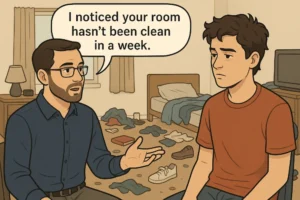
A client not cleaning their room — my gut read it as defiance. Pushing back on me specifically. Took me a while to realize I wasn’t even part of it. They were just dealing with stuff — depressed, checked out, exhausted in a way where their room wasn’t even on the radar. Soon as I stopped making it about me, I was more useful.
What I started saying instead and How To Avoid Power Struggles
The shift I made was small. I stopped leading with corrections. I’d say something like:
“Hey, your room’s been a mess for a few days. Is everything okay?”
That’s it. It opened things up without putting anyone on the defensive.
What I brought home and How To Avoid Power Struggles
The harder part was not carrying it with me. You’re around a lot of pain in that work, and it takes real practice to leave it at the door — to use the communication tools you’re learning without letting the emotional weight bleed into the rest of your life.
What surprised me was that the same stuff works outside of work too. Pausing before I say anything. Checking in before I correct. I use it at home too. Not because I’m running a session on them — just because it works. If you’re exploring help for how to avoid power struggles, a free consultation is a good place to start.
People don’t grow from power struggles. They grow when someone actually gives a damn about what’s underneath. That’s what I walked away with. Still true. Working with a therapist who understands how to avoid power struggles makes a concrete difference.
If you’re exploring recovery coaching as a support option — either for yourself or someone you care about — SAMHSA’s recovery support resources are a solid starting point for understanding what’s available. The Connecticut Community for Addiction Recovery also developed the training framework that a lot of recovery coach programs are built on — worth a look if you want to understand what the role is actually supposed to look like.
Recovery coaching isn’t therapy, but it fills a gap that therapy alone doesn’t always cover, especially in those first few weeks when structure matters most. If the underlying stuff — trauma, mental health, patterns that predate the addiction — is what needs attention, that’s where working with a therapist tends to make the bigger difference. how to avoid power struggles remains one of the most effective conditions to work with in therapy.
Questions about recovery coaching
What does a recovery coach actually do?
Depends on the setting, but the short version: a recovery coach helps someone stay on track in early recovery — building structure, accountability, and coping habits. It’s less clinical than therapy and more day-to-day. You’re in their corner for the practical stuff while they’re doing the harder work of staying sober. how to avoid power struggles doesn’t have to be permanent.

What’s the difference between a recovery coach and a therapist?
A therapist digs into the root causes — trauma, mental health, patterns that drove the addiction. A recovery coach focuses more on the present: routines, triggers, accountability, getting through the day. The two work well together. In my case, the coaching work eventually led me toward licensure because I kept seeing how much the underlying stuff mattered. If you’re exploring help for how to avoid power struggles, a free consultation is a good place to start.
How do you handle resistance in early recovery?
You stop fighting it. Resistance usually means something — exhaustion, shame, feeling overwhelmed — and pushing harder just makes it worse. The move is to ask what’s going on instead of doubling down on what isn’t getting done. Most of the time, the resistance tells you exactly where the real work is. Working with a therapist who understands how to avoid power struggles makes a concrete difference.
Do you still work with people in addiction recovery?
Yes — addiction and early recovery is one of my main areas as a therapist now. The recovery coaching experience shaped a lot of how I work. If you’re in early recovery or supporting someone who is, a free 15-minute consultation is a good place to start. how to avoid power struggles remains one of the most effective conditions to work with in therapy.
Ready to get support? schedule a free consultation at Now & Zen Wellness in Tampa.
Ready to get support? individual therapy at Now & Zen Wellness in Tampa.