
An emotionally unavailable partner is one of the most painful relationship dynamics to navigate — partly because emotional unavailability is so easy to confuse with introversion, independence, or just being busy. Emotional unavailability is one of the hardest relationship problems to name, partly because it doesn’t look like a problem from the outside. The person is there. They’re not actively unkind. They show up for practical things — logistics, finances, events. They might be a good parent or a reliable partner in most visible ways.
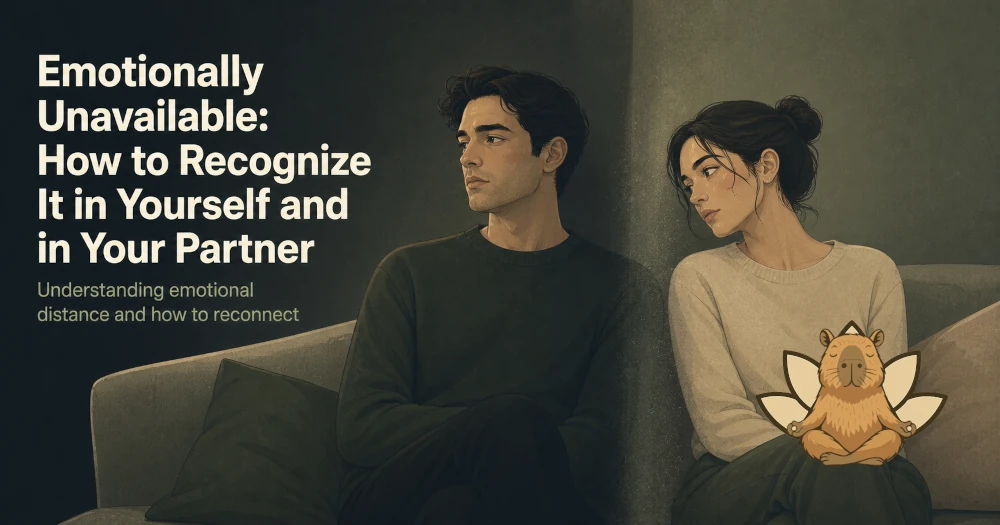
What’s missing is harder to describe: genuine presence, emotional reciprocity, vulnerability, the sense that this person is actually with you even when they’re in the same room. You reach for connection and get something that looks like connection but doesn’t feel like it.
Recognizing an emotionally unavailable partner is important. But understanding that emotional unavailability is often a learned pattern — not a permanent character trait — is what actually opens a path forward. And the most difficult part of this work is recognizing it in yourself, which is where real change begins.
What an Emotionally Unavailable Partner Actually Is
Emotional unavailability is not the same as introversion, or needing time to recharge, or being private. It’s a consistent pattern of being unable or unwilling to engage emotionally in a relationship — to be present, to attune, to share vulnerability, or to receive it from a partner. It exists on a spectrum.
At one end, a person is consistently available for practical connection but struggles with emotional intimacy. At the other, a person maintains physical proximity while being fundamentally unreachable emotionally. The roots are almost always developmental. People do not become emotionally unavailable randomly. They become unavailable because emotional intimacy was either dangerous, unavailable, or punished in their early relationships.
The nervous system learned: getting close means getting hurt. Keep a manageable distance and stay safe.This is not a conscious strategy. It’s a wiring pattern that operates mostly beneath awareness — and it replicates across every significant relationship until it’s directly addressed. emotionally unavailable partner responds well to the right kind of clinical support.
The 7 Signs of Emotional Unavailability and Emotionally Unavailable Partner

1. They Don’t Initiate Emotional Conversations
They respond to what you bring, but they don’t bring things themselves. You rarely hear “I need to tell you something” or “I’ve been thinking about us.” Emotional sharing is something they tolerate rather than initiate. emotionally unavailable partner doesn’t have to be permanent.
2. They Deflect Vulnerability With Humor, Practicality, or Shutdown
When you try to have a real conversation — about your feelings, about what you need, about something that’s been hard — they change the subject, make a joke, pivot to solving the problem, or go quiet. The deflection is automatic and consistent. If you’re exploring help for emotionally unavailable partner, a free consultation is a good place to start.
3. They’re Physically Present but Emotionally Absent
They’re at dinner, at the event, in the bed — but they’re not really there. You notice a quality of absence. Partners often describe this as talking to a wall, or feeling invisible in the relationship. Working with a therapist who understands emotionally unavailable partner makes a concrete difference.
4. They Struggle to Tolerate Your Emotional Distress
When you’re upset, anxious, or sad, they either fix it immediately, minimize it, or exit the room emotionally. The presence of strong emotion in you activates something uncomfortable in them that they manage by creating distance. You learn to manage your own feelings alone because bringing them forward makes things worse. emotionally unavailable partner remains one of the most effective conditions to work with in therapy.
5. They Pull Away When Things Get Close
A pattern that confuses many people: the relationship feels good for a period, connection deepens, and then the emotionally unavailable partner becomes noticeably more distant. This is the intimacy-avoidance dynamic — closeness triggers the nervous system into threat response, and distance is the unconscious regulatory response.

6. Commitments Are Partial or Indefinite
Emotional unavailability often shows up in reluctance to commit fully. Not necessarily to the relationship itself, but to vulnerability within it. Planning together is conditional. Sharing the future is vague. Anything that requires both people to be genuinely invested activates the avoidant pattern. emotionally unavailable partner doesn’t have to be permanent.
7. You Feel Lonelier in the Relationship Than You Did Alone
This is perhaps the clearest marker. The chronic feeling of loneliness in the presence of someone who is technically your partner — that specific ache of being unseen by someone who should see you — is the emotional unavailability dynamic from the inside. If you’re exploring help for emotionally unavailable partner, a free consultation is a good place to start.
Recognizing Emotional Unavailability in Yourself and Emotionally Unavailable Partner

This is harder, and it’s the part that most articles on this topic skip. If you’ve read the section above and found yourself recognizing your own patterns more than your partner’s — the avoidance, the difficulty tolerating their distress, the automatic distance when things get close — that recognition is valuable.
And it’s the starting point for actual change. The emotionally unavailable person is not enjoying the pattern. The distance that protects them from vulnerability also prevents genuine connection. The relationships that frustrate their partners are frustrating them too, in a different way.
Signs you may have developed emotional unavailability:- You find yourself more comfortable as the supportive one than as someone who needs support- Emotional vulnerability from a partner activates anxiety or irritability rather than closeness- You have a history of relationships where partners described you as hard to reach or distant- You’re comfortable with intimacy in its practical forms (doing things for people) but not in its emotional forms (being present with feelings)- You can’t remember the last time you asked someone for help or disclosed something you were genuinely struggling withThese patterns have origins. They were adaptive once. They don’t have to stay. Working with a therapist who understands emotionally unavailable partner makes a concrete difference.
How Therapy Addresses Emotional Unavailability
EMDR for early attachment wounds. Most emotional unavailability has roots in early relationships — experiences of emotional unavailability from caregivers, relational trauma, loss, or environments where emotional expression was unsafe. EMDR processes those stored experiences directly. As the charged memories resolve, the defensive distance becomes less necessary.
Individual therapy for self-understanding. Understanding your own wiring — why you protect yourself with distance, what intimacy actually feels like in your nervous system, what you’re actually afraid of when closeness increases — is work that can happen in individual therapy before or alongside couples work.
Couples therapy for the relational dynamic. Couples therapy addresses the system that both partners have created together. An emotionally unavailable partner and a partner who pursues connection create a specific cycle — one person pursues, one person distances, both feel unseen. Couples therapy interrupts that cycle, creates structure for different kinds of engagement, and helps both partners understand what the other is actually experiencing.
Relationship Therapy in Tampa for Emotional Unavailability

If you recognize yourself — or your relationship — in this description, therapy is the most direct way to address it. Emotional unavailability is not a fixed trait. It’s a learned pattern that responds to treatment, particularly when both partners are willing to look honestly at their own contributions.
Now & Zen Wellness in Carrollwood, Tampa offers individual therapy, couples therapy, and EMDR for relationship patterns including emotional unavailability, avoidant attachment, and intimacy avoidance. Sessions in-person and telehealth available across Florida. A free 15-minute consultation is the first step — no commitment, no pressure, just a conversation about what you’re experiencing and whether therapy is the right fit. emotionally unavailable partner remains one of the most effective conditions to work with in therapy.
FAQ
Q: What does emotionally unavailable mean in a relationship?A: An emotionally unavailable partner is consistently unable or unwilling to engage emotionally — to be present, share vulnerability, or receive it from a partner. They may be physically present and practically engaged but emotionally distant in ways that leave the other partner feeling unseen and lonely.
Q: Can an emotionally unavailable person change?A: Yes. Emotional unavailability is a learned pattern — typically rooted in early relational experiences — not a permanent character trait. Therapy, particularly EMDR for early attachment wounds and couples therapy for the shared dynamic, can produce meaningful change when the person is willing to look at their own patterns.
Q: Is emotional unavailability the same as avoidant attachment?A: They’re closely related. Avoidant attachment is the developmental pattern — learned in early childhood — that underlies most emotional unavailability in adults. Emotional unavailability is how avoidant attachment shows up in adult relationships. Both are addressable in therapy. Q: Can individual therapy help if my partner is emotionally unavailable?A: Yes.
Individual therapy can help you understand the dynamic you’re in, clarify what you need, and decide how to respond. It can also help you examine your own patterns — why you’re drawn to emotionally unavailable partners, and what needs that dynamic is meeting or frustrating.
Q: Should emotionally unavailable couples try couples therapy or individual therapy first?A: Often individual therapy first for the emotionally unavailable partner — to understand and begin to address the roots of the pattern — followed by couples therapy once some stabilization has occurred. In some cases, both can run simultaneously with different therapists. The right order depends on the specific situation. For more information, see the APA research on attachment theory and emotional unavailability.
Ready to get support? schedule a free consultation at Now & Zen Wellness in Tampa.