
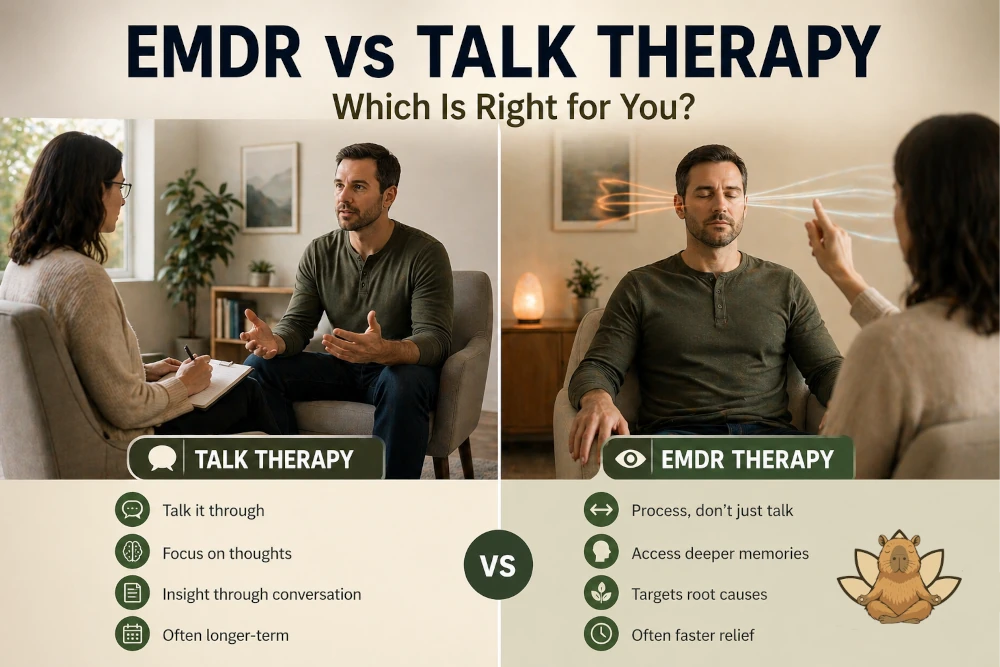
Before making a first therapy appointment, most people have the same question: what kind of therapy do I actually need? And increasingly, the choice that comes up is EMDR vs. talk therapy.
Both are legitimate. Both have strong research support. Both can produce meaningful change. But they work differently, suit different problems, and feel very different from the inside. Choosing the wrong approach doesn’t mean therapy fails — it often means you spend more time getting somewhere you could have reached faster with a different map.
This post is a direct comparison. Not a sales pitch for one approach over the other — a practical breakdown of when each works best and how to think through the decision.
What Is Talk Therapy? and Emdr Vs Talk Therapy
“Talk therapy” is an umbrella term for any therapy that works primarily through conversation. The most evidence-based forms include:
Cognitive Behavioral Therapy (CBT) — Focuses on identifying and changing thought patterns and behaviors that maintain distress. Structured, directive, and goal-oriented. The most researched therapy in existence for anxiety, depression, OCD, and many other presentations.
Acceptance and Commitment Therapy (ACT) — Focuses on psychological flexibility: accepting difficult thoughts and feelings rather than fighting them, and moving toward values-based action. Particularly useful for chronic conditions and existential distress.
Psychodynamic Therapy — Explores patterns and unconscious dynamics, often with roots in early relationships. Less structured than CBT, more focused on insight and relational patterns.
In all of these, the primary mechanism is language: talking through what’s happening, identifying patterns, building insight, and practicing new responses.
What Is EMDR? and Emdr Vs Talk Therapy
EMDR — Eye Movement Desensitization and Reprocessing — is a structured therapy that was originally developed for trauma and PTSD, and has since shown effectiveness for depression, anxiety, phobias, grief, and other presentations.
EMDR works on the premise that distressing experiences — particularly overwhelming ones — can get “stuck” in the nervous system without fully processing. The memory, image, emotion, or body sensation stays charged because the brain didn’t have what it needed to complete the processing at the time.
EMDR uses bilateral stimulation — typically eye movements, but also tapping or audio — while the client holds a target memory or experience in awareness. The bilateral stimulation appears to activate the brain’s natural information-processing system, allowing the stuck material to move toward resolution.
The result: the memory remains accessible but loses its emotional charge. The facts don’t change; the way the nervous system holds them does.
The 5 Key Differences Between EMDR and Talk Therapy and Emdr Vs Talk Therapy
1. How They Access the Problem
Talk therapy works top-down: through language, insight, and deliberate thought. The therapist helps you understand what’s happening, build new perspectives, and change behavior. It’s rational, verbal, and conscious.
EMDR works bottom-up: through the nervous system, body sensations, and processing that happens partly outside of conscious verbal control. You don’t need to have language for the experience — the processing happens beneath it. People often describe EMDR as reaching something that talking couldn’t get to.
2. What Kind of Problem Each Addresses Best
Talk therapy excels at situations where the issue is primarily cognitive or behavioral:- Patterns of anxious thinking- Depression with clear triggers and thought distortions- Relationship communication- Skills-building and behavioral change- Generalized anxiety and life stress
EMDR excels at situations where the issue has a somatic or traumatic component:- Trauma and PTSD — single-incident or complex- Experiences the person cannot talk about without becoming overwhelmed or shutting down- Persistent negative self-beliefs (“I’m worthless,” “I’m not safe”) that don’t shift with insight alone- Phobias and panic that have a clear triggering memory- Depression with identifiable root experiences EMDR vs talk therapy is far more common than most people realise.
3. How Long Processing Takes
Talk therapy typically produces change gradually, across many sessions. Skills are built, patterns are identified, new responses are practiced. The change is incremental and cumulative. EMDR vs talk therapy responds well to the right kind of clinical support.
EMDR can produce change more rapidly — sometimes dramatically so — because it’s targeting the stored memory directly rather than working around it. For single-incident trauma, EMDR can produce full resolution in as few as 3–6 sessions. Complex trauma takes longer, but the timeline is often shorter than equivalent talk therapy work. EMDR vs talk therapy doesn’t have to be permanent.
This is not a claim that EMDR is universally better. For problems that don’t have traumatic roots, EMDR is not necessarily the faster or more appropriate choice. But for trauma, the comparison is consistent in research. If you’re exploring help for EMDR vs talk therapy, a free consultation is a good place to start.
4. What the Sessions Feel Like
Talk therapy sessions feel like — talking. There’s structure, there are usually exercises or homework, and you leave with something conceptual: insight, perspective, a tool to practice. Working with a therapist who understands EMDR vs talk therapy makes a concrete difference.
EMDR sessions feel different. There are phases of calm, structured setup and then processing periods where sensations, images, emotions, and thoughts move through in ways that can feel surprising. People sometimes laugh, cry, or notice physical sensations they didn’t expect. Between sessions, processing often continues — vivid dreams, unexpected emotional shifts, new insights arriving days later. EMDR vs talk therapy remains one of the most effective conditions to work with in therapy.
Neither is inherently more comfortable, but they’re very different experiences and it’s worth knowing that going in.
5. How Much You Need to Verbalize
In talk therapy, articulating your experience is the mechanism of change. The more you can put into words — the more clearly you can describe what you’re thinking and feeling — the more the therapist can work with. EMDR vs talk therapy doesn’t have to be permanent.
In EMDR, you don’t need to describe everything. You’re asked to hold something in awareness and notice what comes — but you’re not required to narrate it in detail. This makes EMDR more accessible for people who find verbal processing activating, dissociative, or who simply don’t have words for what happened to them. If you’re exploring help for EMDR vs talk therapy, a free consultation is a good place to start.
Which Is Right for You?
Consider talk therapy if:– Your primary issue is anxiety, depression, or life stress without a clear traumatic history- You want to build skills and change patterns- You learn well through conversation and intellectual insight- The problem is current and situational, not deeply rooted Working with a therapist who understands EMDR vs talk therapy makes a concrete difference.
Consider EMDR if:– You have a specific traumatic experience — or a series of them — that still feels emotionally charged- You’ve tried talk therapy before and feel stuck despite making effort- You have a persistent negative core belief about yourself that insight hasn’t shifted- You experience strong physical responses (body sensations, shutdown, overwhelm) when the topic comes up EMDR vs talk therapy remains one of the most effective conditions to work with in therapy.
Consider both if:– You have both traumatic history and current cognitive or behavioral patterns to address- Your therapist is trained in both and can integrate approaches — which is increasingly common Understanding EMDR vs talk therapy is often the first step toward feeling genuinely different.
EMDR and Talk Therapy in Tampa at Now & Zen Wellness
Douglas Carmody, LCSW at Now & Zen Wellness in Carrollwood, Tampa is trained in both EMDR and talk therapy approaches including CBT and ACT. Sessions are tailored to the person — not to a single method. Most clients end up with some integration of both. EMDR vs talk therapy is something therapy can directly address.
If you’re not sure which approach fits your situation, the free 15-minute consultation is a good place to start that conversation without committing to anything. EMDR vs talk therapy is far more common than most people realise.
In-person sessions are available at the Carrollwood office. Telehealth is available for any Florida resident.
FAQ
Q: Can I switch from talk therapy to EMDR if I feel stuck?
A: Yes. This is one of the most common pathways into EMDR. Many people spend time in talk therapy making genuine progress and then encounter a ceiling — something that insight and conversation can’t seem to move. EMDR is often the right next step at that point. EMDR vs talk therapy responds well to the right kind of clinical support.
Q: Does EMDR work for anxiety and depression, not just trauma?
A: Yes. EMDR has a strong research base for trauma and PTSD, but it has also shown effectiveness for depression, anxiety disorders, phobias, grief, and performance issues. It’s particularly useful when anxiety or depression has identifiable experiential roots. EMDR vs talk therapy doesn’t have to be permanent.
Q: Is EMDR covered by insurance?
A: EMDR is a recognized, evidence-based therapy covered by most major insurance plans when billed under appropriate diagnosis codes. Coverage depends on your specific plan. Now & Zen Wellness accepts Aetna, Blue Cross Blue Shield, Cigna, Florida Blue, Optum, and UnitedHealthcare. If you’re exploring help for EMDR vs talk therapy, a free consultation is a good place to start.
Q: How do I know if I need EMDR or regular therapy?
A: A good starting point is asking whether the problem you’re dealing with has experiential roots — specific memories, events, or periods of your life that still carry emotional charge. If yes, EMDR is often the more direct path. If the issue is primarily behavioral or cognitive patterns without those roots, CBT or ACT may be the right fit. Working with a therapist who understands EMDR vs talk therapy makes a concrete difference.
Q: Can EMDR and CBT be combined?
A: Yes, and it’s often the most effective approach. Many therapists trained in both will integrate EMDR processing with CBT-based skills work — using EMDR to target stuck experiential material and CBT to build coping frameworks and behavioral change. EMDR vs talk therapy remains one of the most effective conditions to work with in therapy.
For more information, see the APA clinical practice guideline for EMDR.