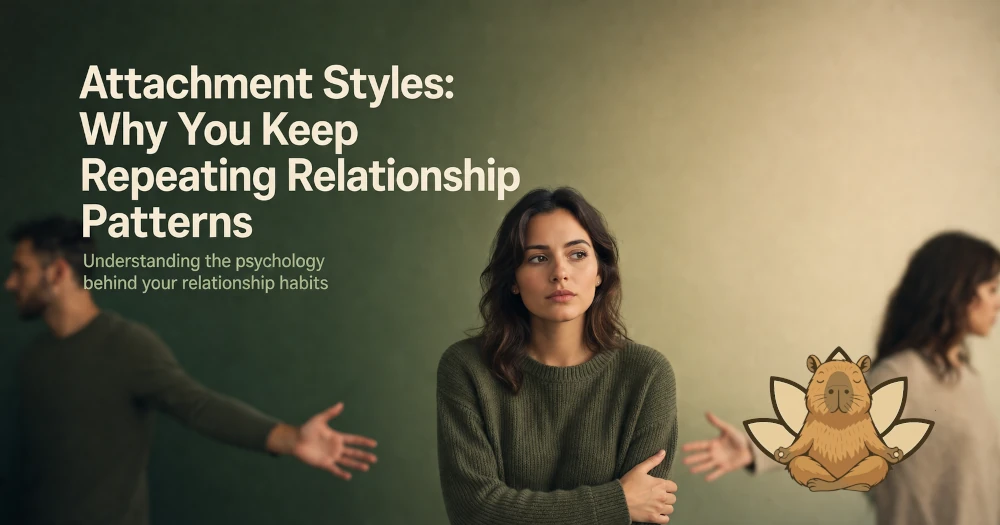
You’ve noticed the pattern. The person who always falls for emotionally unavailable partners. The one who sabotages things right when they start going well. The one who clings harder when they feel someone pulling away, which makes that person pull away further. These are patterns shaped by attachment styles — and they tend to repeat until someone names them.
These patterns aren’t character flaws. They’re not bad luck. They’re attachment styles — and they were formed before you knew you were forming them.
Attachment theory, developed by John Bowlby and expanded by Mary Ainsworth, explains how early experiences with caregivers create a blueprint for how we relate to people for the rest of our lives. The American Psychological Association recognizes attachment-based approaches as among the most well-supported frameworks for understanding adult relationship patterns. The blueprint gets built from answers to very early questions: Is this person reliable? Will they come when I need them? Am I safe when I’m close to someone?
The answers you got — through experience, not words — become the operating system for your adult relationships. If those early answers were inconsistent or frightening, the operating system has some real problems.
The 4 Attachment Styles
Secure attachment
Secure attachment develops when early caregivers were reliably responsive — present enough, consistent enough that the child learned: closeness is safe, needs will be met, it’s okay to depend on people.
Adults with secure attachment styles tend to be comfortable with intimacy, express needs directly, and don’t read normal relationship friction as a sign that everything is collapsing. They can handle conflict without catastrophizing and return to connection once conflict resolves.
It’s the goal — not because it means perfect relationships, but because it makes functional ones possible. You can develop it as an adult even without it in childhood. That’s a lot of what individual therapy is for.
Anxious attachment
Anxious attachment styles develop when caregiving was inconsistent — warm sometimes, unavailable other times, with no pattern the child could rely on. The lesson that stuck: connection is possible, but you have to work for it. Stay alert.
Adults with anxious attachment tend to be hypervigilant to signs a partner is pulling away. Reassurance helps temporarily. Distance feels unbearable. Ambiguity reads as rejection even when it isn’t. The underlying fear is abandonment, and the response — pursuing, escalating, demanding reassurance — often produces exactly what they were afraid of.
Avoidant attachment
Avoidant attachment styles come from caregivers who were consistently unavailable or dismissive. The conclusion the child drew: needing people leads to disappointment. Better to handle things yourself.
Adults with avoidant attachment often value independence above almost everything, pull back when relationships deepen, and may genuinely believe they don’t need much closeness. When a partner moves toward them emotionally, space feels urgent. The cost is often isolation or a series of relationships that never fully develop — not because they don’t want connection, but because closeness triggers something that feels like danger.
Disorganized attachment
Disorganized attachment styles (sometimes called fearful-avoidant) develop when the caregiver was the source of both comfort and fear — abuse, extreme neglect, a frightening person who was also the child’s only safe one. That’s an impossible bind: I need you and you scare me.
Adults with this style often want closeness and fear it at the same time, sometimes in the same conversation. They may swing between pursuit and withdrawal, feel drawn to chaotic relationships, and feel genuinely confused about what they want. This style has the strongest connection to complex trauma and takes the longest to work through.
How Attachment Styles Become Adult Patterns
The attachment system isn’t a memory — it’s automatic. You don’t consciously decide to pursue your partner more intensely when they seem distant. You just feel anxious when they don’t text back, and you text again. This is what makes attachment styles so hard to change through willpower alone — the pattern fires before the conscious mind engages.
The system runs below awareness, which is why insight alone rarely changes much. You can understand exactly why you do something and keep doing it anyway. Knowing your attachment style is useful. It isn’t enough.
Real change in attachment patterns requires learning to regulate the emotional states that drive the behavior — and having experiences in relationships, including with a therapist, that offer a different model of what connection can look like.
The anxious-avoidant trap
The most common painful dynamic in adult relationships is an anxiously attached person with an avoidantly attached one. It often starts as chemistry — the avoidant’s independence feels intriguing; the anxious person’s warmth feels good to someone who usually keeps people at a distance.
Then the relationship deepens and the cycle activates. The anxious partner pursues; the avoidant pulls back. The distance escalates the pursuit; the pursuit triggers more distance. Both people are doing what their wiring tells them to do. Both are getting what they most feared. It’s not intentional. It just grinds on both of them until something breaks. Understanding which attachment styles are at play in your relationship is the first step toward interrupting this cycle.
Can Attachment Styles Change?
Yes. Research by Roisman and colleagues, published in Child Development, found that adults who experienced difficult early attachment but developed secure patterns in adulthood showed outcomes comparable to those who had continuous security from childhood. The concept is called “earned security” — and it’s well documented.
What it actually involves: catching patterns early enough to make different choices, learning to sit with discomfort instead of acting on it automatically, and finding relationships — including the therapeutic relationship — that offer a genuinely different experience of closeness. It takes time. It’s not linear. The nervous system does change, just not quickly. And attachment styles that developed over decades do not shift in a few sessions — but they do shift.
Therapy for attachment patterns in Tampa
Individual therapy is often the most direct route for working with attachment styles — it creates a relationship where those patterns can show up, get named, and get worked with in real time.
EMDR (Eye Movement Desensitization and Reprocessing) is particularly useful when there’s attachment-related trauma — processing the early experiences that built the blueprint in the first place. Couples therapy works with how two people’s styles interact and helps build new patterns together.
At Now & Zen Wellness in Carrollwood, Tampa, attachment comes up constantly — in relationship difficulties, anxiety, depression, the patterns people can’t seem to stop repeating. Sessions are available in person and via telehealth across Florida. A free 15-minute consultation is a good place to start.
The attachment styles you developed in childhood are not a life sentence. The pattern you’re in is not the pattern you’re stuck in.
FAQ
How do I know my attachment style?
The most reliable way is to work with a therapist who can identify your patterns in context. Online assessments can give a rough starting point but often oversimplify. Looking at patterns across relationships — particularly in moments of conflict, distance, or emotional vulnerability — gives more accurate information than a quiz.
Can adults change their attachment style?
Yes. Research on “earned security” shows that people with insecure childhood attachment can develop secure attachment patterns in adulthood through therapy, significant corrective relational experiences, and sustained self-awareness. Change is real, though it requires more than intellectual understanding.
Is anxious or avoidant attachment more difficult to change?
Both change with appropriate work. Disorganized attachment, which typically develops from more severe relational trauma, is the most complex to work with and generally requires longer-term treatment. Anxious and avoidant attachment both respond well to individual and couples therapy.
Should I work on my attachment in individual therapy or couples therapy?
Often both, either simultaneously or sequentially. Individual therapy is valuable for understanding your own patterns and developing regulation skills. Couples therapy addresses how two people’s styles interact. For many people, individual work first creates the foundation for more effective couples work.
What if my partner refuses to do any attachment work?
Your attachment patterns are yours to work with regardless of what your partner does. Individual therapy can help you change your own responses, which often changes the dynamic even when only one person is in treatment.
If you’re unsure which attachment styles apply to you, the clearest way to find out isn’t a quiz — it’s noticing what happens inside you when someone gets close or pulls away. That’s where the pattern lives, and that’s where the work begins.