
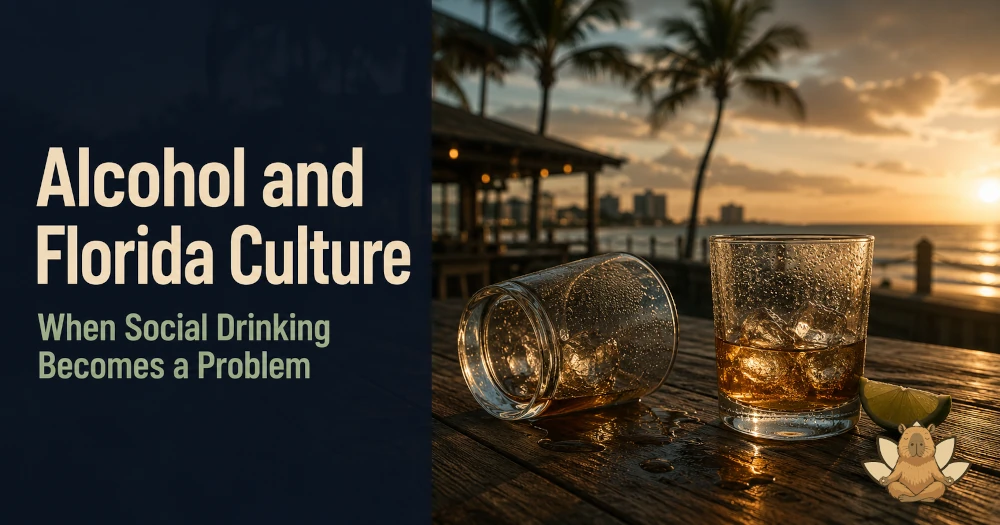
Alcohol use disorder in Florida develops gradually, disguised by a culture that makes drinking feel normal at every occasion. In Florida, drinking is not just a social activity. It’s woven into the landscape. Understanding alcohol use disorder Florida is what brings many people to therapy.
Boat days on Tampa Bay start with the cooler packed at sunrise. Happy hour on Franklin Street runs until 8. There’s a craft brewery every few miles, a rooftop bar attached to every new hotel, and an unspoken expectation at most social and professional gatherings that alcohol is part of the agenda.
This is not unique to Florida, but Florida amplifies it. The year-round outdoor lifestyle, the events, the beach culture, the transplant community trying to build social connections quickly — all of it creates an environment where drinking feels normal, ambient, and largely invisible as a potential problem.
Until it isn’t.

Florida consistently ranks among the highest-consumption states for alcohol in the country. Tampa Bay, in particular, has a vibrant bar and entertainment culture that makes drinking a near-constant backdrop to social life.
This isn’t a moral judgment about the culture. Most people who drink socially in Florida do so without developing a problem. But the environment does create specific conditions that make it harder to notice when drinking has shifted from social to something else:
Frequency disguised as occasion. When there’s always an occasion — a game, a sunset, a Friday, a holiday, a “just because it’s nice out” — it becomes harder to distinguish between drinking at events and drinking as a daily pattern.
Normalization through volume. When everyone around you drinks regularly and heavily, your own consumption is harder to calibrate against a realistic baseline.
Social reward for drinking. Boat invitations, barbecue culture, industry events — in some social and professional circles, drinking is part of access. Not drinking can feel like opting out of the community.
Where Social Drinking Ends and a Problem Begins and Alcohol Use Disorder Florida
The line between social drinking and alcohol use disorder (AUD) is not about frequency or volume alone. The DSM-5 defines AUD based on a pattern of alcohol use that causes clinically significant impairment or distress, assessed across 11 criteria. You don’t have to be drinking every day. You don’t have to have lost a job or a marriage.
The criteria include:
– Loss of control: Drinking more or longer than you intended- Unsuccessful attempts to cut back: Wanting to drink less but not being able to- Time spent: Large amounts of time obtaining, using, or recovering from alcohol- Craving: Strong urge or desire to drink- Failure to fulfill obligations: Neglecting major role responsibilities at work, home, or school- Continued use despite social consequences: Drinking even when it causes relationship problems- Giving up activities: Reducing or abandoning hobbies, relationships, or commitments because of alcohol- Hazardous use: Driving, operating machinery, or taking risks while drinking- Tolerance: Needing significantly more to achieve the same effect- Withdrawal: Physical symptoms when you stop or significantly reduce drinking
Two or three of these criteria = mild AUD. Four or five = moderate. Six or more = severe. Many people would be surprised to count how many apply to them. alcohol use disorder Florida is far more common than most people realise.
The Signs Most People Miss and Alcohol Use Disorder Florida
Drinking More Than You Intended

You said one glass. You finished the bottle. You agreed to leave at 10 and it’s 2 AM. This is loss of control, and it happens gradually — the gap between intention and actual consumption widening over time without any obvious moment it shifted. alcohol use disorder Florida responds well to the right kind of clinical support.
Drinking to Cope with Emotions
There’s a difference between enjoying a drink and needing one. When alcohol becomes the primary tool for managing stress, anxiety, loneliness, boredom, or difficult emotions — when the thought “I need a drink” has urgency rather than preference behind it — that’s a meaningful change in the function alcohol is serving. alcohol use disorder Florida doesn’t have to be permanent.
Organizing Your Schedule Around Alcohol
The social plans that consistently involve drinking. The events without alcohol that feel somehow less appealing. The subtle way certain situations get avoided because drinking isn’t possible there. This reorganization of life around alcohol often precedes awareness that anything has changed. If you’re exploring help for alcohol use disorder Florida, a free consultation is a good place to start.
Physical Symptoms When You Don’t Drink
Sweating, shaking, disrupted sleep, irritability, or anxiety when alcohol isn’t in the system. These are withdrawal symptoms, and their presence indicates physiological dependence. Alcohol withdrawal can be medically serious — more so than withdrawal from most other substances — and often requires medical supervision to manage safely. Working with a therapist who understands alcohol use disorder Florida makes a concrete difference.
Justifying, Minimizing, or Hiding
“I only drink good wine.” “I’m not as bad as [person].” Pouring a drink before your partner gets home. Rinsing the glass before anyone sees it. Moving from drinking in company to drinking alone. These are behavioral patterns the brain develops to protect a behavior it’s become dependent on. alcohol use disorder Florida remains one of the most effective conditions to work with in therapy.
Why Florida Makes It Harder to See
Other places have seasons, snow days, stretches of weather that naturally interrupt outdoor drinking culture. Florida doesn’t. The party is always on, which means there’s never a natural pause that forces the question. alcohol use disorder Florida is far more common than most people realise.
Additionally, Florida has a large transplant population — people who moved here relatively recently and are still building social connections. Alcohol can become a lubricant for those connections in a way that, over time, means the connections and the alcohol become entangled. Cutting back on drinking feels like cutting back on belonging. alcohol use disorder Florida responds well to the right kind of clinical support.
And Florida’s treatment culture, while robust, tends to concentrate in very visible, acute-intervention contexts: detox, rehab, 30-day programs. The middle ground — someone who is drinking too much but hasn’t lost everything yet — can feel like they don’t qualify for help. They do. alcohol use disorder Florida doesn’t have to be permanent.
What Asking for Help Actually Looks Like
You don’t have to have hit a defined bottom to seek support. Many of the most successful outcomes in addiction treatment happen with people who came in early — not in crisis, not in detox, but worried enough to have an honest conversation. If you’re exploring help for alcohol use disorder Florida, a free consultation is a good place to start.

Therapy for alcohol use disorder is not a judgment. It is a structured, collaborative process of understanding what role alcohol has been playing in your life — what needs it’s meeting, what it’s costing you, and what a sustainable path forward looks like. Working with a therapist who understands alcohol use disorder Florida makes a concrete difference.
Motivational Interviewing is an approach specifically designed for people who are ambivalent about change — and ambivalence is completely normal. You can want to stop and also not be sure you want to stop. Therapy creates space to work with that ambivalence rather than demanding you resolve it before you arrive. alcohol use disorder Florida remains one of the most effective conditions to work with in therapy.
EMDR can be useful when the drinking has roots in trauma or earlier experiences that haven’t been processed. Dual diagnosis treatment is available for people dealing with alcohol use alongside depression, anxiety, or other mental health conditions. Understanding alcohol use disorder Florida is often the first step toward feeling genuinely different.
Alcohol Use Disorder Treatment in Tampa and Carrollwood
At Now & Zen Wellness in Carrollwood, Tampa, addiction therapy includes individual sessions, dual diagnosis support, and coordination with medical providers when appropriate. In-person and telehealth options are both available. alcohol use disorder Florida is something therapy can directly address.
If you’re not sure whether what you’re dealing with is a problem — that uncertainty itself is information worth exploring. A free 15-minute consultation is a conversation, not a commitment. alcohol use disorder Florida is far more common than most people realise.
FAQ
Q: How do I know if I have a drinking problem or just drink a lot?
A: The clinical distinction isn’t about quantity alone — it’s about impact and control. If drinking is causing problems in your relationships, work, health, or finances; if you’ve tried to cut back and found it harder than expected; if you’ve noticed tolerance increasing or withdrawal symptoms when you stop — these are signs worth discussing with a professional. alcohol use disorder Florida responds well to the right kind of clinical support.
Q: Can I quit drinking on my own?
A: Some people can reduce or stop without formal support. However, if you drink heavily and regularly, stopping abruptly can be medically dangerous due to alcohol withdrawal syndrome, which can include seizures and other serious complications. Medical supervision during detox is advisable in those cases. alcohol use disorder Florida doesn’t have to be permanent.
Q: Does alcohol use disorder mean I’m an alcoholic?
A: Alcohol use disorder is the current clinical term, replacing older language like “alcoholism.” It describes a spectrum — mild, moderate, and severe — rather than a binary. You don’t have to identify as an alcoholic to have a problematic relationship with alcohol that responds well to treatment. If you’re exploring help for alcohol use disorder Florida, a free consultation is a good place to start.
Q: Will therapy require me to stop drinking completely?
A: Not necessarily, at least not immediately. Motivational Interviewing and harm reduction approaches work with people who are not yet ready for complete abstinence. Goals are established collaboratively based on what you’re ready for and what is clinically appropriate. Working with a therapist who understands alcohol use disorder Florida makes a concrete difference.
Q: Is addiction therapy confidential?
A: Yes. Everything disclosed in therapy is protected by HIPAA and strict professional ethics. Addiction-related disclosures are not reported to employers, law enforcement, or family members without your explicit consent. alcohol use disorder Florida remains one of the most effective conditions to work with in therapy.
For more information, see the SAMHSA National Helpline for substance use treatment.
Ready to get support? schedule a free consultation at Now & Zen Wellness in Tampa.
Ready to get support? individual therapy at Now & Zen Wellness in Tampa.