
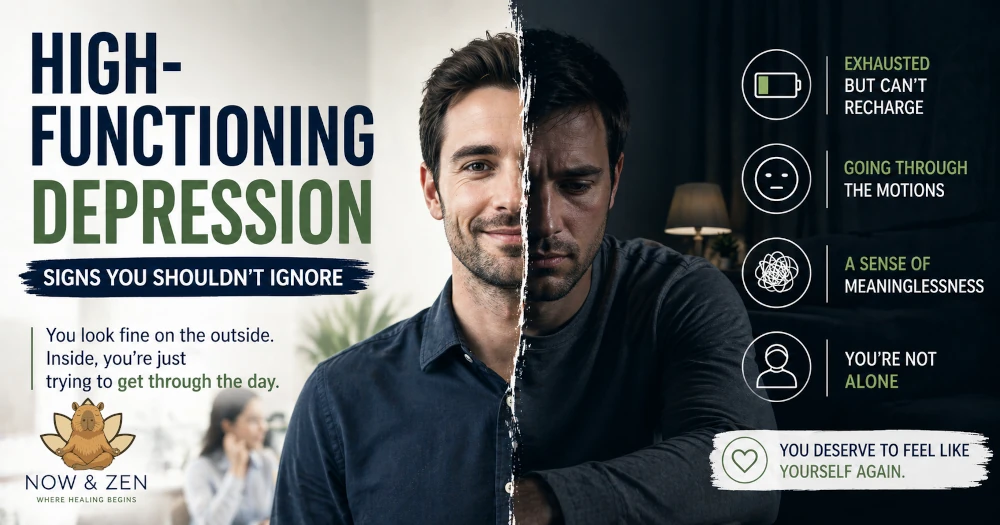
The people I see for depression usually aren’t falling apart. They’re at work. They’re managing. Ask them how they’re doing and they’d say fine — and mostly mean it. What they wouldn’t say is that fine has felt hollow for longer than they can explain.
High-functioning depression doesn’t look like the version in movies. You’re keeping your appointments, making it to work, showing up. From the outside, nothing’s obviously wrong.
Inside is a different story. The tiredness doesn’t go away with sleep. You do the things, but the reason you’re doing them has gone somewhere you can’t locate. It’s not sadness exactly — more like the whole thing has lost its contrast.
Functioning makes it easy to convince yourself nothing’s actually wrong.
It is.
What high-functioning depression actually is
High-functioning depression isn’t an official DSM-5 category, but what it describes is clinically real. You can be depressed and still get things done. The depression doesn’t prevent functioning — it just drains the experience of it.
In clinical terms, this is usually Persistent Depressive Disorder, sometimes called dysthymia. Lower-grade than major depression, but it lasts longer and has a way of becoming the background noise of someone’s life. Some people also meet criteria for Major Depressive Disorder and are simply functioning through it on willpower and routine.
The depression is real. The functioning masks it — from other people, and usually from the person themselves.
The signs nobody sees and High-Functioning Depression
At work you’re fine. At home you’re not.
You’re competent and present in public. But when you get home and close the door, it collapses. You sit on the couch and don’t want to move. There was something you were going to do. You don’t do it. Most people who know you have no idea.
The fatigue that sleep doesn’t touch.
You can sleep eight hours and wake up depleted. Not sleepy — empty. It’s not really physical tiredness. It’s what happens when you run constantly on low reserves, when everything you do feels like it costs more than it returns.
You’ve stopped feeling much.
Things that used to actually feel like something don’t anymore. You’re at dinner with people you like and you’re somewhere else inside. You’re not miserable. You’re just not really there. The actions are happening. The feeling isn’t.
A sense that none of it adds up.
Not hopelessness exactly. You don’t think things will necessarily get worse. But a creeping sense that you’re doing all the right things and it doesn’t add up to anything. That you’ve forgotten what you’re working toward, or why you started.
This is different from burnout, though the two often coexist. Burnout is situational. High-functioning depression follows you out of any situation.
You keep telling yourself you should be fine.
You have a good life. Other people have it worse. You should be grateful. You’re probably just tired.
That internal argument is itself a symptom. One of depression’s most consistent moves is convincing you that what you’re experiencing isn’t real enough to deserve attention. It’s wrong about that, but it’s very convincing.
Why it gets missed and High-Functioning Depression
The doctor doesn’t flag it because you look fine and haven’t brought it up. Your friends don’t notice because you’ve gotten good at projecting competence. And you don’t bring it up because you half-believe your own dismissal.
Some people live this way for years. Decades. I’ve had people describe it in session as having forgotten that things could feel different — they thought this was just what being an adult felt like.
“I should just be grateful”
This thought shows up in almost every person I work with who has high-functioning depression, and it does real damage.
Gratitude is worth cultivating. But “I should be grateful” used as a reason not to acknowledge what you’re feeling is a way of abandoning yourself. Your nervous system doesn’t compare your circumstances to someone else’s before deciding whether to be in pain. Depression doesn’t check your income or your family situation before settling in.
Your life containing good things doesn’t mean you’re not suffering. Both can be true at once, and usually are.
What treatment looks like
High-functioning depression responds well to therapy. The American Psychological Association notes that depression is among the most treatable mental health conditions, with the majority of people seeing significant improvement with treatment. A lot of the work is examining the thought patterns that maintain the flatness — including the habit of dismissing your own experience before anyone else gets the chance to. Some of the work is behavioral: getting back into things that used to matter before they feel meaningful again, because waiting for meaning to arrive first usually doesn’t work. If the depression has deeper roots in earlier experiences, EMDR is worth considering.
Most people notice something shifting within the first couple months. The ceiling on what’s possible is considerably higher than the depression is currently telling you.
Depression therapy in Tampa
At Now & Zen Wellness in Carrollwood, individual therapy for depression is pretty direct: you talk about what’s actually happening, not what you think you should be feeling. We build something that fits your life — including a life that looks, from the outside, completely fine.
Telehealth is available anywhere in Florida. You can start with a free 15-minute call — no intake forms, just a conversation about what’s going on.
If something in this post resonated, that’s worth paying attention to. You don’t have to be in crisis to deserve support. Reach out here to get started. If you’re exploring help for high-functioning depression, a free consultation is a good place to start.
FAQ
Is high-functioning depression a real diagnosis?
In clinical terms, this is usually Persistent Depressive Disorder, sometimes called dysthymia. Lower-grade than major depression, but it lasts longer and has a way of becoming the background noise of someone’s life. Some people also meet criteria for Major Depressive Disorder and are simply functioning through it on willpower and routine.
How long can it last without treatment?
A long time. Persistent Depressive Disorder requires two years by definition, and plenty of people live with it much longer without realizing there’s a name for what they’re experiencing. Many describe having forgotten that things could feel different. Working with a therapist who understands high-functioning depression makes a concrete difference.
Can I have this if I’m not sad?
Yes. A lot of people with depression describe it as numbness, flatness, or just a sense that nothing quite lands the way it used to. Prominent sadness isn’t required. high-functioning depression remains one of the most effective conditions to work with in therapy.
Can therapy help if I’m not in crisis?
Yes. Therapy tends to work better before things get bad, not after. Waiting for a crisis is one of the more common mistakes people make with mental health. Working with a therapist who understands high-functioning depression makes a concrete difference.
How is this different from burnout?
Burnout is tied to a specific situation — usually work — and responds to rest and changed circumstances. Depression follows you across contexts and doesn’t lift with rest alone. A lot of people have both, which therapy can address together. high-functioning depression remains one of the most effective conditions to work with in therapy.