
Dual diagnosis in Tampa refers to the simultaneous presence of a substance use disorder and a mental health condition — and it is far more common than either diagnosis alone. Most people who struggle with addiction are not struggling with addiction alone. Behind the substance use, there is almost always something else — anxiety that never got treated, depression that found its own solution, trauma that the body learned to manage through substances before anything more effective was available.
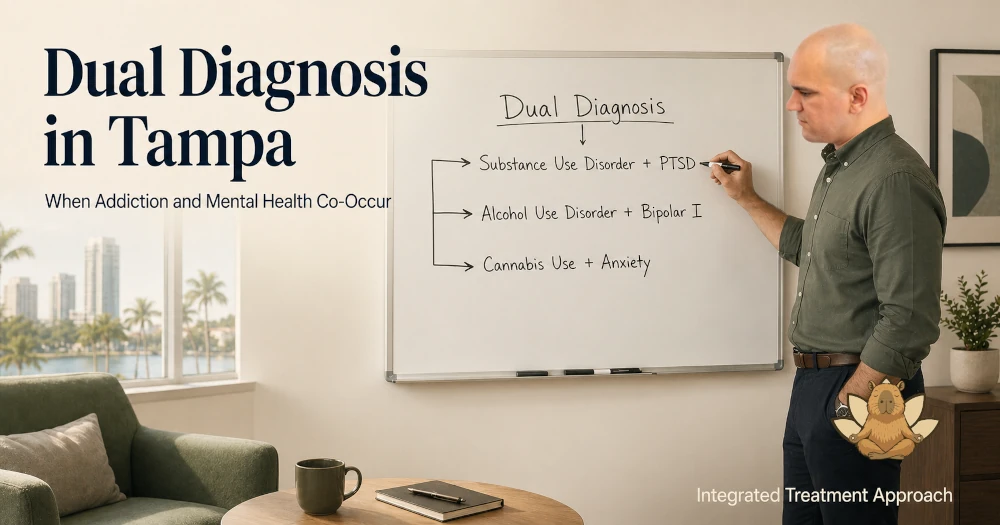
Dual diagnosis Tampa clients — people dealing with both a substance use disorder and a co-occurring mental health condition — represent a significant portion of people who come through therapy doors. The research is clear: roughly 50% of people with a substance use disorder also meet criteria for a mental health diagnosis, and the overlap runs in both directions.
Understanding what dual diagnosis means, why treating one condition without the other fails, and what integrated treatment in Tampa actually looks like — that’s the point of this post.
What Dual Diagnosis Actually Means and Dual Diagnosis Tampa
Dual diagnosis (also called co-occurring disorders) refers to the presence of both a substance use disorder and at least one other mental health condition. Common combinations include:
– Alcohol use disorder + depression — alcohol depresses the central nervous system and is one of the most common ways people self-medicate depression; the depression then deepens as alcohol use increases- Stimulant use + anxiety — stimulant use can cause anxiety, but many people with pre-existing anxiety use stimulants to feel more functional; the cycle becomes self-reinforcing- Opioid use + trauma/PTSD — opioids effectively suppress the hyperarousal of PTSD; people living with untreated trauma often find opioids feel like the first relief they’ve experienced- Cannabis use + social anxiety — cannabis reduces social anxiety short-term; avoidance of social situations increases long-term; anxiety grows as tolerance develops- Alcohol use + PTSD — one of the most common and most undertreated combinations; alcohol reduces hypervigilance temporarily while preventing trauma from processing
None of these combinations are unusual. All of them are better understood as a single complex problem than as two separate ones.
Why They Almost Always Co-Occur and Dual Diagnosis Tampa
The relationship between addiction and mental health is bidirectional. Both can cause the other. Both can make the other worse. And for many people, the roots go back to the same source.
The self-medication hypothesis is the most intuitive explanation: people in psychological pain find things that reduce the pain. Substances often work — at least initially, at least partially. Alcohol reduces anxiety. Opioids quiet the hypervigilance of PTSD. Stimulants lift the flatness of depression. The brain learns this association quickly, and the behavior becomes reinforced before the cost becomes visible.
Shared neurobiological vulnerability is another piece. The brain systems that regulate mood, stress response, and impulse control overlap significantly with the systems affected by substance use. People with certain temperamental and neurological profiles are at higher risk for both, not because one caused the other, but because they share common soil.
Trauma as a common root is perhaps the most clinically significant. Adverse childhood experiences (ACEs) — abuse, neglect, household dysfunction, early loss — dramatically increase the risk of both substance use disorders and mental health conditions in adulthood. When trauma is the root, neither depression nor addiction can be fully addressed without addressing the trauma itself.
Why Treating One Side Doesn’t Work and Dual Diagnosis Tampa
This is the core clinical problem. Addiction treatment programs that don’t assess and address co-occurring mental health conditions have significantly higher relapse rates. Mental health treatment that ignores substance use is working against itself.
When someone enters addiction treatment with untreated PTSD, depression, or severe anxiety, the discomfort of sobriety — which removes the regulatory function substances were performing — becomes unmanageable. The relapse is not a failure of willpower. It’s the nervous system finding the only available solution.
When someone begins therapy for depression or trauma while actively using substances, the substance use disrupts processing, impairs neuroplasticity, and keeps the nervous system in a state that makes therapeutic change difficult to sustain.
This is not a criticism of any particular program. It’s a structural problem that integrated treatment is designed to solve. dual diagnosis Tampa responds well to the right kind of clinical support.
What Integrated Dual Diagnosis Treatment Looks Like
Integrated treatment means both conditions are addressed within the same clinical framework — not referred out, not treated sequentially, but held together in the same room by the same provider. dual diagnosis Tampa doesn’t have to be permanent.
Assessment first. Understanding what drives what. Is the anxiety making the drinking worse, or is the drinking producing anxiety? Is the depression lifting during periods of sobriety, or does it predate substance use by years? The answers shape the treatment. If you’re exploring help for dual diagnosis Tampa, a free consultation is a good place to start.
Motivational Interviewing (MI) is a core approach in dual diagnosis work. It meets ambivalence without arguing. Many people with co-occurring disorders are not fully convinced that change is possible — they’ve tried and failed, or they’ve never seen what stable sobriety with treated mental health actually looks like. MI works with that ambivalence rather than against it. Working with a therapist who understands dual diagnosis Tampa makes a concrete difference.
EMDR for trauma is one of the most effective tools in dual diagnosis work when trauma is part of the picture. The research on EMDR’s effectiveness for PTSD is robust, and clinical work consistently shows that processing traumatic material reduces the pull of substances that were managing it. This doesn’t mean EMDR alone treats addiction — but untreated trauma is one of the most reliable predictors of relapse, and addressing it changes the equation. dual diagnosis Tampa remains one of the most effective conditions to work with in therapy.
CBT for both. Cognitive Behavioral Therapy has strong evidence for both substance use and depression/anxiety. Identifying the thought patterns and behavioral cycles that drive both — the anticipatory cognitions, the permission-giving thoughts, the avoidance patterns — gives clients tools that operate on both conditions simultaneously. Working with a therapist who understands dual diagnosis Tampa makes a concrete difference.
Relapse prevention that accounts for mental health. Traditional relapse prevention (identify triggers, build a support network, have a plan) is necessary but insufficient when untreated depression or trauma is the primary trigger. Integrated relapse prevention addresses the emotional and neurological state that precedes craving — not just the external circumstances. dual diagnosis Tampa remains one of the most effective conditions to work with in therapy.
Dual Diagnosis Therapy in Tampa and Carrollwood
At Now & Zen Wellness, co-occurring disorders are treated as a single integrated clinical picture. Whether the presenting issue is addiction with underlying depression, trauma with self-medication, or substance use tied to anxiety or relationship patterns — the work accounts for all of it. Understanding dual diagnosis Tampa is often the first step toward feeling genuinely different.
Sessions are available in-person at the Carrollwood, Tampa office and via telehealth for all Florida residents. Insurance accepted includes Aetna, Blue Cross Blue Shield, Cigna, Florida Blue, Optum, and UnitedHealthcare. dual diagnosis Tampa is something therapy can directly address.
If you’re carrying both — if you’ve struggled with substances and have never had the mental health piece fully addressed — starting that conversation is the most practical thing you can do. A 15-minute free consultation is available. dual diagnosis Tampa is far more common than most people realise.
FAQ
Q: What is dual diagnosis and why does it matter?
A: Dual diagnosis refers to having both a substance use disorder and a co-occurring mental health condition. It matters because treating one without the other leads to significantly worse outcomes — higher relapse rates, slower recovery, and continued suffering from the untreated condition. dual diagnosis Tampa responds well to the right kind of clinical support.
Q: Can I be treated for both addiction and mental health at the same time in Tampa?
A: Yes. Integrated treatment — addressing both conditions simultaneously within the same clinical framework — is the evidence-based standard of care for co-occurring disorders. Now & Zen Wellness provides this integrated approach in Carrollwood, Tampa and via telehealth. dual diagnosis Tampa doesn’t have to be permanent.
Q: Does having a mental health condition mean I’ll always struggle with addiction?
A: No. Treating the underlying mental health condition is one of the most powerful things a person can do to support sustained recovery. When the psychological pain that substances were managing is addressed directly, the compulsion to use it decreases significantly. If you’re exploring help for dual diagnosis Tampa, a free consultation is a good place to start.
Q: Is trauma always part of dual diagnosis?
A: Not always, but it’s extremely common. Adverse childhood experiences and adult trauma dramatically increase risk for both substance use and mental health conditions. When trauma is present, addressing it is essential to lasting recovery. Working with a therapist who understands dual diagnosis Tampa makes a concrete difference.
Q: What should I do if I think I have co-occurring depression and substance use?
A: Talk to a mental health provider who specializes in co-occurring disorders — someone who can assess both conditions and treat them in an integrated way. You don’t need to be fully sober before starting therapy. A 15-minute consultation can help you figure out the right first step. dual diagnosis Tampa remains one of the most effective conditions to work with in therapy.

For more information, see the SAMHSA resources on co-occurring disorders and dual diagnosis.