
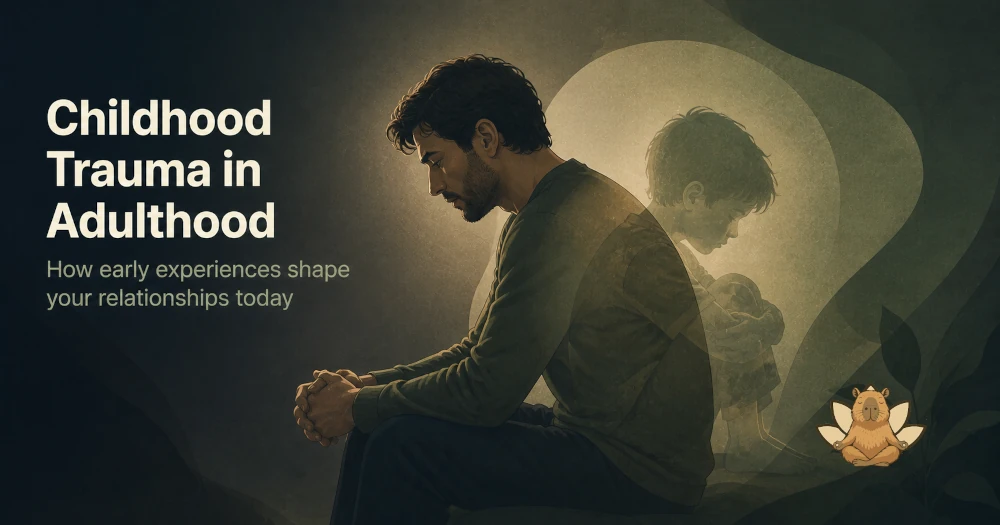
Childhood trauma therapy Tampa clients often don’t arrive identifying as trauma survivors. They come in because their relationships keep following the same painful pattern. Because they react to situations in ways they can’t fully explain. Because something has felt fundamentally off for as long as they can remember, and they can’t trace it to anything specific enough to call it a reason.
Most of what I see in this work doesn’t fit the image of trauma that most people carry — a single catastrophic event, a dramatic rupture that explains everything. More often it’s the quieter stuff. The family that never talked about hard things. The parent who was emotionally unavailable. The house where you were physically safe but never quite felt safe. These experiences leave marks. The marks just aren’t always visible, and they don’t always have names.
What Counts as Childhood Trauma and Childhood Trauma Therapy Tampa
The word “trauma” is still understood by most people as a response to something severe and obvious — abuse, a serious accident, a loss. But the clinical definition is broader. Childhood trauma includes any experience that overwhelms a child’s developing capacity to cope and that leaves a lasting imprint on the nervous system.
The CDC’s research on Adverse Childhood Experiences documents the long-term health and relational consequences of early exposure to abuse, neglect, household dysfunction, and other adversity. The data shows a dose-response relationship — the more adverse experiences, the greater the downstream risk across physical health, mental health, and relationships. But you don’t need a high ACE score to have been affected.
Emotional neglect, chronic criticism, a parent’s untreated mental illness or substance use, a household where conflict was constant but nothing was ever resolved — these aren’t typically recognized as trauma. But they shape the developing nervous system in the same fundamental ways. Many of the people I work with spent years not applying the word “trauma” to their history, because nothing dramatic enough had happened. The quiet versions are still real. Working with a therapist who understands childhood trauma therapy Tampa makes a concrete difference.
How Early Experiences Wire the Brain and Childhood Trauma Therapy Tampa
The developing brain is not a miniature adult brain. It is a highly plastic organ whose architecture is being built in real time, based on the environment it is trying to survive. When that environment is chronically threatening, unpredictable, or emotionally depleting, the brain adapts — not in ways that are wrong, but in ways that made sense for what was happening then.
The problem is that those adaptations don’t automatically update when the environment changes. A child who learned to monitor a parent’s moods for early signs of danger doesn’t simply stop doing that at 18. A child who learned that needing things led to rejection doesn’t easily unlearn that in adulthood.
The National Institute of Mental Health recognizes that early trauma alters development in brain regions governing memory, emotion regulation, and stress response. These changes are real, measurable, and — this is the part people need to hear — treatable. You are not overreacting. You are running the software your early life installed. childhood trauma therapy Tampa remains one of the most effective conditions to work with in therapy.
How Childhood Trauma Shows Up in Adult Life
Childhood trauma rarely announces itself directly. It shows up in patterns — in the relationships you keep finding yourself in, in how your body responds to stress, in the thoughts about yourself that feel like facts. Here are the five most common presentations I work with. childhood trauma therapy Tampa doesn’t have to be permanent.
In Your Relationships
Attachment patterns formed in childhood become the template for adult relationships. If your early caregivers were inconsistent — warm sometimes, cold or frightening at others — you may find yourself anxiously scanning your partner’s moods for any sign of withdrawal. If you learned that people leave, you may keep them at a distance before they can.
If conflict in your house of origin led to chaos or danger, you may avoid it entirely in your current relationships, building resentment in place of resolution. These patterns are not character flaws. They are strategies that made sense in the family you grew up in. They just never got updated for the relationship you’re in now. For people navigating these dynamics in their partnerships, relationship therapy can help separate what belongs to the present from what belongs to the past. If you’re exploring help for childhood trauma therapy Tampa, a free consultation is a good place to start.
In Your Body
Trauma lives in the body before it lives in the mind. Chronic tension in the shoulders, jaw, or chest. A baseline sense of unsafety that has no immediate cause. Fatigue that doesn’t resolve with rest. Gut problems, headaches, and physical symptoms that intensify during stress. The body is not misbehaving — it is still protecting you from a threat that ended years ago. It just was never told the threat was over. Working with a therapist who understands childhood trauma therapy Tampa makes a concrete difference.
In How You See Yourself
The conclusions children draw about themselves during difficult experiences become the internal operating system they carry into adulthood. “I’m too much.” “I’m not enough.” “I’m defective.” “If people really knew me, they’d leave.” These aren’t just negative thoughts — they are organized beliefs that shape every interaction, every decision about whether to ask for what you need, and every moment when something good happens and you’re waiting for it to fall apart. They feel factual because they’ve been present so long. childhood trauma therapy Tampa remains one of the most effective conditions to work with in therapy.
In Your Emotional Responses
Present-day triggers — a tone of voice, a look, a moment of conflict — can activate emotional responses that belong to the past. The reaction feels disproportionate because it is. You’re not only responding to what’s happening now. You’re responding to what this moment reminds your nervous system of. Past experiences are stored physiologically and get activated in the present by stimuli that pattern-match to them. Understanding this doesn’t make the reactions stop. But it changes how you relate to them. Understanding childhood trauma therapy Tampa is often the first step toward feeling genuinely different.
In Your Sense of Safety
Many adults who grew up in difficult environments describe a pervasive feeling that something bad is about to happen, even when there’s no objective threat. They scan rooms. They struggle to relax in their own home. They feel most comfortable when they’re controlling something. This isn’t anxiety in the ordinary sense — it’s a nervous system that was trained to treat the world as unpredictable, and stayed ready just in case. That readiness was protective once. Now it costs more than it earns. childhood trauma therapy Tampa is something therapy can directly address.
Why “Getting Over It” Doesn’t Work
The most common thing I hear from people carrying childhood trauma is some version of this: “I know it happened a long time ago. I should be over it by now.” This is compassionate toward everyone else and brutal toward themselves. The reason willpower and insight don’t resolve trauma is that trauma isn’t stored as a narrative — as a story about something that happened.
It’s stored as a physiological state. The nervous system holds it in patterns of activation, tension, and reactivity that exist below the level of conscious thought. You can understand exactly what happened and exactly why it affected you, and still be fully controlled by its effects. Knowing the origin of a pattern doesn’t update the pattern. Willpower and insight don’t update the nervous system. Specific, targeted therapeutic work does. childhood trauma therapy Tampa is far more common than most people realise.
Childhood Trauma Therapy Tampa: What the Work Looks Like
Effective treatment for childhood trauma is not one thing. It unfolds in phases, and the order of those phases matters. The first phase is stabilization — building the internal resources and nervous system regulation needed to do deeper processing without becoming overwhelmed. This phase is sometimes undervalued by clients who want to get to the “real work,” but it is the foundation everything else depends on.
Moving into reprocessing without adequate stabilization is how trauma therapy earns its reputation for making things worse. The second phase is processing — working directly with the stored traumatic material. EMDR therapy is particularly suited to childhood trauma because it processes material at the neurological level without requiring detailed verbal narration of every difficult experience.
For people who have avoided trauma therapy because they couldn’t face telling someone what happened, this changes what’s possible. The third phase is integration — making sense of what has been processed and how it applies to daily life, relationships, and the ongoing work of being a person. This is often where the most durable change happens, when new patterns start replacing old ones not just in the therapy room but outside it. childhood trauma therapy Tampa responds well to the right kind of clinical support.
Childhood Trauma Therapy in Tampa and Carrollwood

At Now & Zen Wellness in Carrollwood, I work with adults carrying the long-term effects of childhood experiences — whether those experiences were dramatic and clearly traumatic, or quieter and harder to name. Childhood trauma therapy Tampa sessions are private, confidential, and held at 14021 N Dale Mabry Hwy, with telehealth available for clients anywhere in Florida.
A first session is a conversation. We talk about what brought you in, what’s been showing up in your life, and whether the work I do is a good fit for where you are. No commitment before we’ve talked. For people navigating these patterns inside a partnership, couples therapy is available for the relational side of this work. If any of this sounds like where you are, schedule a free consultation. That’s the starting point.
FAQ
Does childhood trauma always involve abuse or neglect?
No. Childhood trauma includes any experience that overwhelms a child’s capacity to cope — including emotional neglect, household dysfunction, a parent’s unmanaged mental illness, chronic instability, or caregiving that was inconsistent rather than absent. Many people I work with experienced what they describe as “normal” childhoods and are genuinely surprised to learn how significantly their early environment shaped them. childhood trauma therapy Tampa doesn’t have to be permanent.
Can adults recover from childhood trauma?
Yes. The brain retains neuroplasticity throughout life, which means patterns laid down in childhood can be changed. Recovery is not about erasing the past. It’s about updating the nervous system’s response to it so that the past stops running the present. People who have been carrying the effects of childhood trauma for decades make meaningful, lasting change in treatment. If you’re exploring help for childhood trauma therapy Tampa, a free consultation is a good place to start.
How is trauma therapy different from regular talk therapy?
Trauma therapy targets the stored physiological and neurological patterns that talk therapy doesn’t directly reach. Approaches like EMDR work at the level of the nervous system, not just the narrative. Regular therapy builds insight and coping skills, which have real value. Trauma therapy addresses what’s underneath the need for those coping skills in the first place. Working with a therapist who understands childhood trauma therapy Tampa makes a concrete difference.
What if I don’t remember specific events?
Memory is not required for childhood trauma therapy Tampa to work. Many of the patterns that bring adults into treatment — relationship difficulties, emotional reactivity, chronic low self-worth — are stored in the body and the nervous system, not in explicit narrative memory. EMDR can target present-day symptoms and patterns even when the specific origins aren’t consciously accessible.
How long does childhood trauma therapy take?
It depends on the scope. Adults working with a defined difficult period often see significant change within months. Adults with complex, pervasive childhood experiences typically work longer. What I can offer after a thorough intake is an honest read of what we’re likely working with and how long similar cases have taken. That conversation is more useful than a number given before I know your history. childhood trauma therapy Tampa remains one of the most effective conditions to work with in therapy.